Quantum.Tech 2026: A Defining Moment for the Industry – and Just the Beginning
When we launched Quantum.Tech in 2019, our ambition was straightforward: create the event where the world's quantum ecosystem could come together to share ideas, build partnerships and accelerate the commercialisation of quantum technologies.
Last month in Boston, that vision reached a new level.
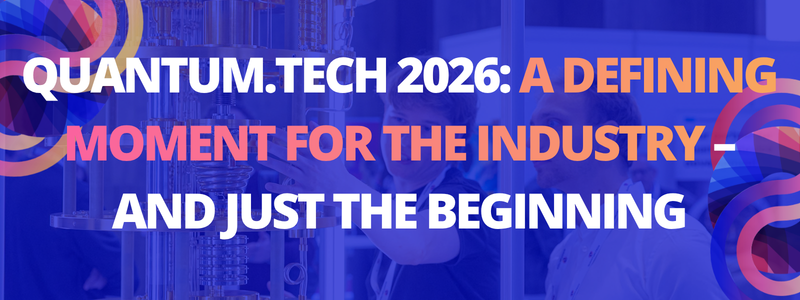
Quantum.Tech World 2026 was by far our largest and most ambitious edition to date. We welcomed more than 1,200 attendees—a remarkable increase from around 400 attendees the previous year—alongside 100+ sponsors and exhibitors, making it one of the largest dedicated quantum events in the world.
However, what made this year's event so significant wasn't simply its growth in numbers. It was the quality of the people and conversations taking place.
Over two days, Boston became the centre of the global quantum community. We were privileged to welcome some of the most influential figures in the field, including Professor Peter Shor, whose groundbreaking algorithm fundamentally changed the future of cryptography; 2025 Nobel Laureate Professor John Martinis, one of the pioneers of superconducting quantum computing; and Paul Dabbar, former U.S. Deputy Secretary of Energy, alongside senior leaders from government, national laboratories, Fortune 500 enterprises, defence organisations and the world's leading quantum technology companies.
The programme reflected the breadth of the industry itself. Discussions ranged from fault-tolerant quantum computing and post-quantum cybersecurity to quantum networking, sensing, AI, high-performance computing and real-world enterprise adoption. What was particularly striking was how the conversation has evolved. Only a few years ago, the industry was largely debating whether quantum would deliver transformational impact. Today, the discussion has shifted decisively towards how organisations prepare, invest and deploy quantum technologies alongside AI and advanced computing infrastructure.
Boston was the perfect backdrop for those conversations.
For the first time, attendees also had the opportunity to go behind the scenes at two of the world's foremost quantum research institutions through exclusive site tours of MIT and Harvard University's quantum facilities. These experiences offered a rare opportunity to see world-leading research first-hand, meet the scientists driving breakthrough discoveries and strengthen the connection between cutting-edge academic research and commercial adoption. They proved to be one of the highlights of the week and sold out well in advance of the event.
Events like Quantum.Tech are never built by one organisation alone. They succeed because of an extraordinary community of speakers, advisory board members, sponsors, exhibitors, partners and attendees who are willing to invest their expertise and collaborate openly. I want to thank everyone who contributed to making this year's event such a success.
Of course, success also creates responsibility.
One of the clearest takeaways from this year's conference was that quantum is no longer developing in isolation. The future of enterprise technology lies at the convergence of Quantum, Artificial Intelligence and High-Performance Computing. Increasingly, CIOs, Chief AI Officers, quantum leaders and enterprise technology executives are solving common challenges around infrastructure, optimisation, cybersecurity and next-generation computing.
That is why, in May 2027, we will take the next major step in the evolution of the event with the launch of Compute.Tech, co-located alongside Quantum.Tech World.
Our ambition is to create the world's leading event focused on the convergence of quantum, AI and HPC, bringing together not only the pioneers developing these technologies, but also the enterprise leaders responsible for deploying them at scale. Alongside an even stronger quantum programme, attendees can expect greater Fortune 500 participation, expanded government engagement, enhanced executive networking and new opportunities to explore how these technologies will reshape every major industry.
Quantum.Tech 2026 felt like an inflection point—not just for our event, but for the industry itself.
If this year's conference demonstrated how far the quantum ecosystem has come, I'm convinced that Quantum.Tech and Compute.Tech 2027 will demonstrate where it is heading next.
We're already planning our most ambitious edition yet, and I can't wait to welcome the global community back to Boston next May.