Hype vs Pragmatism
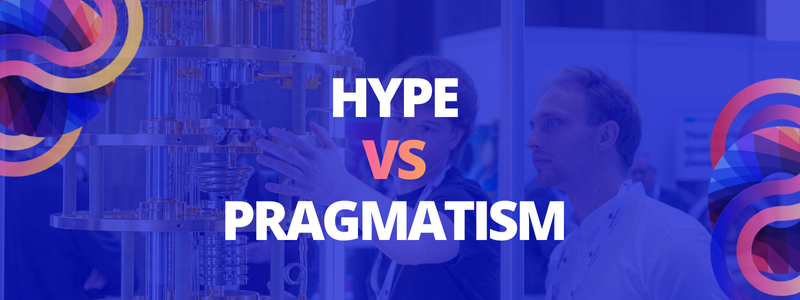
As the year draws to a close, I often find myself reflecting on the strange duality that surrounds quantum technologies: a field powered by extraordinary scientific progress, yet continually pulled between runaway hype and grounded pragmatism. Curating the Quantum.Tech series puts me right at that crossroads. I see, on one side, the palpable excitement from industry, investors, and governments who sense that quantum will reshape entire sectors. On the other, I encounter the researchers and engineers who—while enthusiastic—know just how far we still are from broad, fault-tolerant, commercially transformative quantum computing.
Balancing those forces has become one of the most important and delicate parts of my role. I recently spoke to this at length with Yuval Boger at QuEra when he kindly interviewed me for his ‘Superposition Guy’s’ podcast.
The pace of marketing-driven narratives has only accelerated. Each year brings new announcements of “breakthroughs,” “quantum supremacy,” and “production-ready” platforms. Some of them represent genuine progress; others represent the understandable impulse to signal momentum. But for organisations trying to make decisions—CISOs assessing quantum-safe transitions, financial institutions exploring quantum-enhanced optimisation, or pharmaceutical companies hoping computational chemistry will leap forward—the line between potential and practicality can blur quickly.
That’s where the challenge lies: how do we create a space where ambition is encouraged but realistic expectations are maintained?
Through Quantum.Tech, I’ve had to adopt something like a dual mindset. The curator in me wants to showcase the astonishing work happening across qubit architectures, materials engineering, quantum networking, and hybrid quantum-classical algorithms. But the responsible communicator in me feels an equal duty to interrogate claims, cut through inflated timelines, and ask the questions that matter: What can be done today? What still requires scientific breakthroughs? What does “quantum advantage” truly mean in a commercial context?
Over the past year, the conversations that resonate most are those that openly acknowledge constraints: error rates, decoherence, scaling bottlenecks, manufacturing challenges, the complexity of benchmarking, and the real effort required to build quantum-literate teams. When speakers emphasise these realities alongside successes, it creates a much healthier dialogue—one where organisations can engage without feeling misled, overwhelmed, or disillusioned.
Curating the hype is not about pessimism. It’s about sustainability. If we let expectations balloon unchecked, the industry risks repeating the AI winters of the past—periods where over-promising led to collapse in investment and credibility. But when we offer a clear picture of quantum’s near-term utility—quantum-inspired methods, improved simulation accuracy, hardware progress, advances in middleware, early-stage optimisation explorations—we help lay the groundwork for long-term impact.
I’ve also seen first-hand that the most productive sessions aren’t the ones that declare quantum will “revolutionise everything.” They’re the ones where practitioners admit: “We don’t know yet—but here’s what we’re learning,” or “Here’s where classical and quantum can complement each other,” or “Here’s what businesses should realistically pilot in the next 12–24 months.” I’d like to name check Jay Lowell at Boeing, Dani Couger at Lockheed Martin, and Philip Intallura at HSBC; who’s keynotes I have seen in the past 12 months have really showcased this moment in time.
That mix of honesty and ambition attracts more serious engagement than hype ever has.
As we move into a new year, I’m convinced that the industry’s credibility hinges on our ability—as event curators, researchers, vendors, and end-users—to communicate quantum technology in a way that is both visionary and grounded. The breakthroughs will come. They always do, though rarely on the timelines we predict. In the meantime, my goal with Quantum.Tech next year remains simple: to create a forum where clarity triumphs over noise, where progress is celebrated without distortion, and where the path from research to real-world impact is illuminated with integrity.
If we can continue fostering that balance, the quantum ecosystem will mature not through hype cycles but through genuine, sustainable advancement—exactly the trajectory it deserves.
I look forward to showcasing this next year in Boston at Quantum.Tech World 2026.