The One Single Gap between Health Science and Clinical Practice
Boston, MA -- Sept 14 2026: Translating scientific evidence into consistent clinical practice remains a central challenge in maternal care. While evidence may already exist around practices that can improve outcomes, implementation can vary across workflows, institutions, and patient populations.
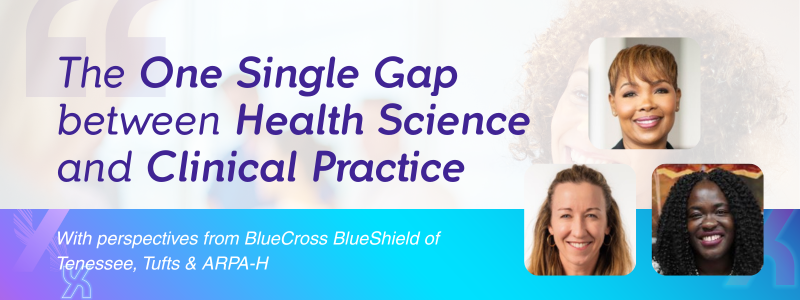
Speaking ahead of Women's HealthX, Dr. Ndidiamaka Amutah-Onukagha, Julia A. Okoro Professor of Black Maternal Health, Director and Founder, Center for Maternal Health Advancement, Tufts University School of Medicine, Dr. Katherine Arnold, Program Manager, ARPA-H, and Dr. Andrea Willis, SVP & Chief Medical Officer, Blue Cross Blue Shield Tennessee, discuss where the gap between scientific evidence and clinical practice persists and what healthcare leaders should consider when translating evidence into care.
The challenge is implementation
For Dr. Ndidiamaka Amutah-Onukagha, many of the practices that can improve maternal outcomes are already known.
Severe hypertension must be recognized and treated quickly. Standardized hemorrhage protocols can save lives. Postpartum care should begin earlier and continue beyond a single six-week visit, while mental health screening should occur more than once and be connected to treatment.
She also emphasizes that patients are more likely to engage with care when they feel respected, heard, and culturally understood.
"The gap is implementation."
Dr. Ndidiamaka Amutah-Onukagha
Julia A. Okoro Professor of Black Maternal Health, Director and Founder, Center for Maternal Health Advancement, Tufts University School of Medicine
Evidence-based practices, she explains, are not applied consistently across hospitals, communities, or populations. Some health systems have comprehensive safety bundles, care coordinators, and escalation protocols, while others lack the staffing or resources to operationalize them.
Even within the same institution, patient experience may differ based on race, insurance status, language, geography, or which clinician happens to be on duty.
Closing the science-to-practice gap, Dr. Amutah-Onukagha says, requires measurement, accountability, workforce training, community partnership, and a willingness to examine where bias and institutional practices affect care.
Moving scientific possibility to the bedside faster
For Dr. Katherine Arnold, the gap between what science makes possible and what happens in clinical practice is central to her role as a Program Manager at ARPA-H.
Her focus is on looking at what is scientifically possible, considering how it could impact patient care at the bedside, and accelerating the process of translating that learning into care.
"What we do at ARPA is we look at what is possible from a scientific perspective and then look at how it could impact patient care at the bedside."
Dr. Katherine Arnold
Program Manager, ARPA-H
Dr. Arnold describes the aim as making that translation process happen in years rather than decades, so that what is being learned can move more quickly into patient care and lead to improvement.
Science has to fit the realities of the patient
Dr. Andrea Willis identifies another part of the science-to-practice gap: how scientific knowledge is incorporated into clinical workflows across different patient populations.
Science tells clinicians to pay attention to early warning signs of complications during pregnancy, but Dr. Willis stresses that applying that knowledge is not one-size-fits-all.
She emphasizes the importance of considering a patient's previous health history, how it may influence pregnancy, and how social drivers of health may also have an impact.
"Science is great, but it has to be coupled with the environment in which a patient lives."
Dr. Andrea Willis
SVP & Chief Medical Officer, Blue Cross Blue Shield Tennessee
For healthcare professionals, her perspective highlights the importance of considering scientific evidence alongside individual health history, social drivers of health, and the environment in which a patient lives.
What healthcare leaders need to consider
Across the three perspectives, the science-to-practice gap is not simply about whether evidence exists. It is also about whether evidence-based practices are implemented consistently, how quickly scientific learning reaches patient care, and how clinical workflows account for differences across patients and populations.
Their responses point to several areas for healthcare leaders to consider: consistent implementation of evidence-based practices, measurement and accountability, workforce training, community partnership, faster translation of scientific learning into patient care, and greater consideration of patient history, social drivers of health, and the environment in which patients live.
Closing the gap between science and practice therefore depends not only on knowing what can improve outcomes, but on creating the workflows, resources, training, and accountability needed to apply that knowledge consistently in care.
Women’s HealthX 2026 | From Rhetoric to Results
Encore Boston Harbor | December 3-4 2026
Bypass abstract market rhetoric to evaluate real-world health economics, regulatory compliance mandates, and care delivery systems. Join the region's foremost health plan medical directors, hospital COOs, biopharma innovators, and enterprise benefits buyers anchoring our 2026 tracks.