When Reproductive Medicine Moves Faster, How Do We Make Better Decisions?
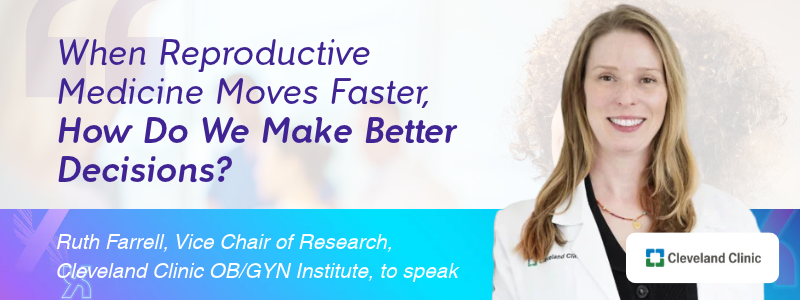
Boston, MA -- November 2026: In reproductive medicine, innovation can create new possibilities remarkably quickly. But every new test, technology and source of information creates another question alongside it: how do patients make genuinely informed decisions about what comes next?
It is a question that sits at the intersection of medicine, technology and ethics, and one that Ruth Farrell, MD, MA of Cleveland Clinic has spent her career examining.
Farrell is a board-certified OB/GYN and Vice Chair of Research for Cleveland Clinic's OB/GYN and Women's Health Institute, with additional work spanning bioethics and genomic medicine. Her research explores the clinical and ethical questions that emerge as new biomedical technologies move into reproductive healthcare, with particular focus on informed consent, shared decision-making and the way patients navigate increasingly complex choices.
The question isn't simply what reproductive medicine can do next. It's how we help patients make informed decisions when it can.
That distinction matters. Advances in reproductive medicine and genetics can provide clinicians and patients with information that was previously inaccessible. But more information does not automatically make a healthcare decision simpler.
Genetic screening and diagnostic technologies can place patients and families in front of deeply consequential choices. The quality of care therefore depends not only on whether the science is accurate, but on how evidence is communicated, how individual values are incorporated and whether patients are genuinely equipped to understand the options in front of them.
Farrell's work brings those questions into the same conversation as innovation itself. Her research focuses on the processes surrounding the introduction of new genetic and reproductive technologies into women's healthcare, including decision analysis, shared decision-making and informed consent.
It is an important counterpoint to one of the dominant conversations in women's health. Progress cannot be measured by the speed at which new technologies emerge alone. What ultimately matters is whether innovation produces better healthcare, better evidence and better decisions for the women expected to benefit from it.
This December, Farrell joins leaders from across clinical care, research, life sciences and health innovation at Women's HealthX in Boston as we move the conversation from what is possible in women's health to what meaningful progress looks like in practice.
Women's HealthX 2026 | From Rhetoric to Results
Encore Boston Harbor | December 3-4 2026
Move beyond the headlines shaping women's health to examine the research, clinical models, investment decisions and technologies determining what happens next. Join leaders spanning health systems, life sciences, research, health plans, employers and innovation in Boston this December.