Why Women’s Health Innovation Must Move From Science to Bedside Faster
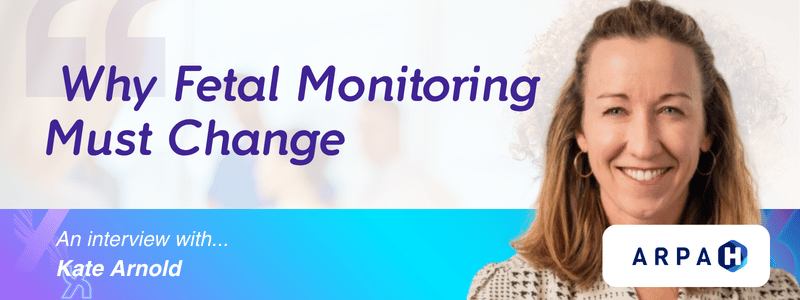
Boston, MA -- September 18 2026: Maternal mortality and morbidity are often examined through the catastrophic events that occur at the end of a patient's pregnancy or hospital stay.
However, according to Dr. Kate Arnold, Program Manager at ARPA-H, healthcare leaders must look further upstream at the smaller clinical decisions that can increase a patient's risk throughout pregnancy, labor and delivery.
Speaking ahead of Women's HealthX, Dr. Arnold explains why fetal monitoring, unnecessary C-sections and the gap between scientific progress and bedside care require urgent attention.
One priority is reducing unnecessary C-sections. Dr. Arnold explains that these procedures can increase the risk of complications such as infection and hemorrhage, which contribute to poor maternal mortality outcomes.
Making earlier, better-informed decisions requires clinicians to have more precise information about the health of both the mother and baby. However, one of the primary technologies used during labor still leaves considerable room for uncertainty.
"They tell us when a baby's doing really well, and they tell us when a baby's not doing well. But there's a middle category that literally just means we don't know. And that happens in 75% of moms in labour."
Dr. Kate Arnold
Program Manager, ARPA-H
Dr. Arnold is referring to fetal monitors, which she believes are among the maternal health diagnostics most in need of modernization.
Current monitoring can identify when a baby is doing well or is clearly in distress. The challenge is the middle category, where the available information does not provide clinicians with a definitive answer.
According to Dr. Arnold, this uncertainty occurs in 75% of mothers during labor. When clinical teams must rely heavily on judgment, there is a risk of babies being born hypoxic, unanticipated neonatal intensive care unit admissions and unnecessary C-sections.
Dr. Arnold notes that C-sections increase the risk of maternal mortality threefold. More precise tools could help clinical teams better understand how a baby is doing and make more informed decisions during the critical period of delivery.
This challenge is central to Dr. Arnold's work at ARPA-H. As Program Manager for MOX, Making Obstetric Care Smart, she is leading work to develop new tools for use in labor and delivery, with the aim of providing clinicians with more information about mothers and babies.
The four-year program has deployed $30 million of its total $90 million allocation. Dr. Arnold notes that the underlying technology has not changed in 50 years, creating an opportunity to significantly modernize maternity care.
The goal is not scientific discovery in isolation. It is ensuring that new technology reaches clinical teams and improves care at the bedside.
"What we do at ARPA is we look at what is possible from a scientific perspective and then look at how it could impact patient care at the bedside. And then our timeline is making that process years, not decades."
Dr. Kate Arnold
Program Manager, ARPA-H
For Dr. Arnold, closing the gap between scientific possibility and clinical practice is fundamental to her role. Innovation must be translated quickly enough to produce a measurable improvement in patient care, rather than remaining disconnected from the realities of labor and delivery.
Technology, however, is only part of the challenge.
Dr. Arnold also points to the disjointed nature of the U.S. healthcare system and the level of responsibility placed on patients to arrange appointments and navigate different services after giving birth.
Expecting someone who has recently had a baby to coordinate every aspect of her own follow-up care may not be realistic. While technology can support better clinical decisions, maintaining continuity after delivery may require more human contact and stronger support for patients.
The same need to listen more closely to patients can be seen in the growing use of social media for maternal health information.
Dr. Arnold does not view patients seeking information online as the central problem. Instead, she believes it can signal that patients are not receiving the time, answers or discussion they need within traditional healthcare settings.
Decisions such as choosing between a repeat C-section and a vaginal birth after C-section require detailed conversations about a patient's health, previous delivery and future plans. These discussions can be difficult to complete during a 15-minute appointment.
When patients do not feel heard, they may turn to other sources for guidance. For healthcare leaders, the response should include examining how clinical services can better meet patients' information needs.
Dr. Arnold also highlights the role of maternity benefits in retaining women in the workplace. Replacing an employee creates significant onboarding costs for a business, while flexibility around when and how mothers return to work can support retention. Access to childcare is another essential consideration.
At Women's HealthX, Dr. Arnold will join the panel "Why Maternal Mortality Persists in High-Income Countries." She will share insights from MOX and examine how better tools could reduce unnecessary C-sections and unanticipated NICU admissions while improving outcomes for mothers and babies.
She sees the event as an opportunity to bring together the diverse stakeholders required to move innovation from scientific development to the bedside. Scientific progress alone will not transform care unless healthcare leaders, clinicians, researchers, innovators and other partners work together to bring new solutions into practice.
Modernizing maternity care requires both better technology and a system capable of using it effectively. The challenge for healthcare leaders is ensuring that progress happens in years, not decades.
Women's HealthX 2026 | From Rhetoric to Results
Encore Boston Harbor | December 3-4 2026
Bypass abstract market rhetoric to evaluate real-world health economics, regulatory compliance mandates, and care delivery systems. Join the region's foremost health plan medical directors, hospital COOs, biopharma innovators, and enterprise benefits buyers anchoring our 2026 tracks.