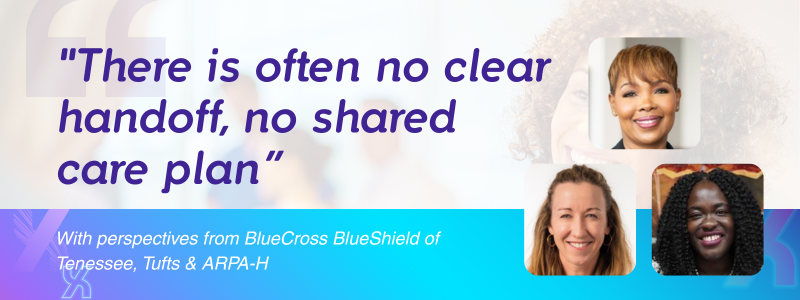
"There is often no clear handoff, no shared care plan, and no single person accountable for ensuring that follow-up happens."
Boston, MA -- Sept 12 2026: Women can move through pregnancy, childbirth, and postpartum recovery across multiple parts of the healthcare system. Yet the way care is delivered does not always provide continuity between them.
Speaking ahead of Women's HealthX, Dr. Andrea Willis, SVP & Chief Medical Officer, Blue Cross Blue Shield Tennessee, Dr. Katherine Arnold, Program Manager, ARPA-H, and Dr. Ndidiamaka Amutah-Onukagha, Julia A. Okoro Professor of Black Maternal Health, Director and Founder, Center for Maternal Health Advancement, Tufts University School of Medicine, discuss why women continue to fall through gaps between primary care, maternity services, and postnatal care, and where stronger coordination and support may be needed.
The coordination gap between maternity and primary care
For Dr. Andrea Willis, a central challenge is the lack of coordination between the primary care women receive and their maternity care.
These services may sometimes be provided by the same physician or healthcare practitioner, but often they are not. Dr. Willis identifies this lack of coordination as one of the ways women can fall through the cracks.
She emphasizes the need to continue following women after pregnancy and to create a warm handoff back to primary care.
"There should be a warm handoff back to the PCP or the OBGYN should definitely be given that information to the PCP."
Dr. Andrea Willis
SVP & Chief Medical Officer, Blue Cross Blue Shield Tennessee
Dr. Willis also stresses that communication should involve everyone responsible for the patient's care and that the patient should be a vital part of that conversation.
A disjointed system places responsibility on new mothers
Dr. Katherine Arnold identifies another challenge: an incredibly disjointed healthcare system combined with an expectation that patients take responsibility for making their own appointments.
In the United States, she notes, ideas around patient autonomy and responsibility can place the responsibility for arranging these appointments on patients themselves. Following childbirth, however, she questions whether this is a reasonable expectation.
"I don't know if that's truly a reasonable expectation for someone who's just had a baby, you know, everyone's just trying to make it through the day."
Dr. Katherine Arnold
Program Manager, ARPA-H
Her comments raise an important consideration for healthcare organizations about how much responsibility patients should be expected to carry for arranging their own follow-up care after childbirth.
Dr. Arnold also points to the need for greater human support, describing this as an area where "we just need more human touches."
Care is organized around individual encounters
For Dr. Ndidiamaka Amutah-Onukagha, the challenge extends beyond individual handoffs. She identifies a broader structural issue: healthcare is organized around individual encounters rather than the full continuum of a woman's life.
A patient may receive prenatal care from one team, deliver at a hospital where she has never met the clinicians, attend a single postpartum appointment, and then be expected to reconnect with primary care on her own.
"There is often no clear handoff, no shared care plan, and no single person accountable for ensuring that follow-up happens."
Dr. Ndidiamaka Amutah-Onukagha
Julia A. Okoro Professor of Black Maternal Health, Director and Founder, Center for Maternal Health Advancement, Tufts University School of Medicine
At the same time, the postpartum period can bring significant logistical and emotional demands. New mothers may be managing recovery, infant care, work, transportation, insurance issues, and sleep deprivation.
Dr. Amutah-Onukagha warns that requiring women to navigate a fragmented system at this moment can result in some being lost to care.
She also notes that ACOG has called for postpartum care to be treated as an ongoing process rather than one isolated visit and recommends that responsibility for the patient's continuing care be clearly transferred to a primary medical home.
Building stronger connections across the care pathway
Dr. Amutah-Onukagha identifies several ways to strengthen continuity, including closed-loop referrals, shared records, community health workers, doulas, home visiting, earlier postpartum contact, and stronger connections between obstetric, primary, cardiovascular, behavioral health, and pediatric care.
She also identifies pediatric settings as a potential point of connection because mothers may attend their infants' appointments even when they are unable to attend their own.
What this means for healthcare professionals and systems
Across the three perspectives, several challenges emerge: coordination between maternity and primary care, responsibility for arranging follow-up, clear handoffs after pregnancy, and connections between the different professionals and services involved in a woman's care.
Their responses point to several areas healthcare leaders should consider: stronger coordination between maternity and primary care, clear handoffs following pregnancy, greater accountability for ensuring follow-up happens, more human support, and less reliance on new mothers to navigate disconnected services independently.
For clinicians, health systems, and health plans, these perspectives highlight the importance of looking beyond individual encounters and considering how women move between services throughout maternity and postpartum care.
Women’s HealthX 2026 | From Rhetoric to Results
Encore Boston Harbor | December 3-4 2026
Bypass abstract market rhetoric to evaluate real-world health economics, regulatory compliance mandates, and care delivery systems. Join the region's foremost health plan medical directors, hospital COOs, biopharma innovators, and enterprise benefits buyers anchoring our 2026 tracks.