Are Maternity Benefits a Cost Center or a Workforce Strategy?
Boston, MA -- Sept 1 2026: Employers have largely moved beyond asking whether maternity benefits matter.
The more difficult question is: What do they actually deliver?
For some organizations, the answer is improved employee wellbeing. For others, it's retention, attendance, productivity, and long-term workforce stability. Yet measuring those outcomes remains surprisingly difficult.
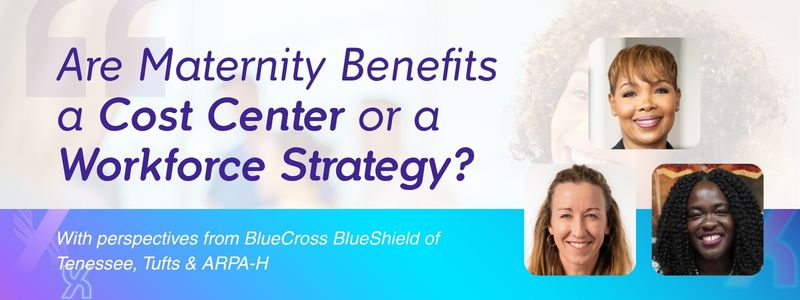
Ahead of Women's HealthX, we asked three healthcare leaders for their perspective:
- Dr. Katherine Arnold, Program Manager, ARPA-H
- Dr. Andrea Willis, SVP & Chief Medical Officer, Blue Cross Blue Shield of Tennessee
- Dr. Ndidiamaka Amutah-Onukagha, Julia A. Okoro Professor of Black Maternal Health and Founder of the Center for Maternal Health Advancement, Tufts University School of Medicine
Their responses point to a common conclusion:
Maternity benefits are no longer simply an employee benefit.
They're increasingly becoming a workforce strategy.
Retention Starts Before Someone Hands in Their Notice
One of the most consistent themes to emerge was retention. Organizations spend significant time and money attracting talent, yet often underestimate the role maternity support plays in keeping employees once they become parents.
As Dr. Katherine Arnold explains:
"I think improving maternity benefits will lead to better retention, which automatically increases a business value."
Dr. Katherin Arnold
Program Manager, ARPA-H
For Dr. Arnold, the conversation extends beyond maternity leave itself. Flexibility around returning to work and access to childcare can have a significant impact on whether women remain in the workforce after having children.
The implication is straightforward: A successful return-to-work strategy may be just as important as the maternity benefit itself.
Workforce Outcomes Matter
For Dr. Andrea Willis, maternity and parental benefits should be viewed through a broader workforce lens.
Their value isn't limited to supporting employees during pregnancy. The impact can be felt across attendance, productivity, engagement, and retention.
"[Looking at maternity benefits through a broader workforce lens] leads to better retention, better attendance, better productivity."
Dr. Andrea Willis
SVP & Chief Medical Officer, Blue Cross Blue Shield of Tennessee
Dr. Willis also highlights mental health support as a critical component of the equation.
When organizations invest in both maternal health and mental wellbeing, they create an environment where employees are more likely to remain engaged and maintain long-term relationships with their employer.
In other words: Better support can create better workforce outcomes.
The Real Question Isn't Whether or not Benefits Exist
Perhaps the most challenging perspective came from Dr. Ndidiamaka Amutah-Onukagha.
Her argument is that employers are often measuring the wrong thing.
Many organizations focus on whether maternity benefits exist.
Fewer examine whether employees can actually use them.
"Employers should evaluate more than whether a benefit technically exists."
Dr. Ndidiamaka Amutah-Onukagha
Founder of the Center for Maternal Health Advancement, Tufts University School of Medicine
According to Dr. Amutah-Onukagha, employers should also ask: #
- Can employees find the benefit?
- Can they afford to use it? Do they trust it?
- Can they access it without harming their career progression?
These questions often reveal a very different picture of employee experience.
She also points to a growing body of evidence showing that paid parental leave can improve parental and infant health outcomes, reduce stress, and support maternal mental health.
If You're Going to Invest, Measure Something Meaningful
The challenge for many employers is not deciding whether to offer maternity benefits.
It's proving their impact.
Dr. Amutah-Onukagha suggests organizations move beyond participation metrics and instead focus on outcomes such as:
- Retention after childbirth
- Absenteeism
- Disability duration
- Employee satisfaction
- Healthcare utilization
- Maternal complications
- Successful return-to-work rates
These measures can help organizations understand whether benefits are creating genuine value for employees and the business alike.
Women’s HealthX 2026 | From Rhetoric to Results
Encore Boston Harbor | December 3-4 2026
Bypass abstract market rhetoric to evaluate real-world health economics, regulatory compliance mandates, and care delivery systems. Join the region's foremost health plan medical directors, hospital COOs, biopharma innovators, and enterprise benefits buyers anchoring our 2026 tracks.