Beyond Volatility: Aurele Storno on Mastering Risk and Resilience in Modern Investing
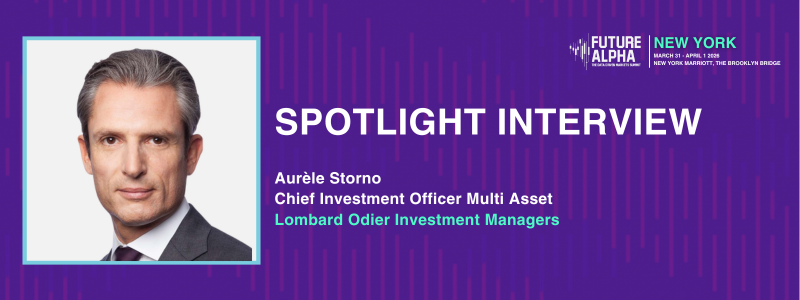
Spotlight Interview with Aurèle Storno, Chief Investment Officer Multi Asset at Lombard Odier Investment Managers.
Aurèle, many institutional investors still rely on traditional volatility-based risk models. From your CIO vantage point, where are these frameworks breaking down and what must replace them to better capture today’s market complexity?
Volatility measurement is just one piece of the global risk puzzle - it’s the most commonly used, but I would argue it’s often misunderstood. Volatility represents only price fluctuations, but as investors, our main concern is assessing potential losses. When viewing investments through a risk lens, it’s crucial to consider much more than just volatility. For example, tail risk adjustments are essential, as they capture extreme, less predictable events. These are also closely tied to execution risk, particularly liquidity. On the other end of the spectrum, valuation can serve as a significant risk indicator as well. To expand further, even momentum can be viewed as a form of risk signal. From my experience managing risk-driven solutions since 2013, I’ve found that a broader, more integrated framework is crucial for addressing the complexities of today’s markets, rather than relying solely on traditional models.
Uncertainty is often more damaging than measurable risk. How do you incorporate ambiguity, unknown unknowns, and non-quantifiable regime shifts into portfolio construction and decision-making?
This is the risk manager’s ultimate challenge. Despite our best efforts to develop sophisticated models, we cannot fully account for what lies “outside the map” - the unknown unknowns. In my experience, this reality calls for more fundamental principles like diversification and prudent money management, which ultimately require humility. Rule number one is to always diversify - this helps avoid concentration risks and biases, which can be tracked and managed. But diversification goes beyond simply holding different assets: it involves using a broad set of indicators, measurement techniques and models to ensure our process is resilient and doesn’t develop fragilities, such as over-relying on a single parameter. Additionally, convex strategies, which can benefit from market disruptions, should be integrated into portfolios as structural or strategic components. These strategies don’t depend on forecasting specific future events; rather, they capitalize on the consequences of market dislocations, such as volatility spikes or spread widening, when they eventually materialize.
Behavioural finance has historically been discussed more than applied. What behavioural biases do you see most affecting institutional portfolios and how can active managers design processes that systematically mitigate them?
Many institutional investors are vulnerable to behavioral biases such as anchoring, herd behavior, status quo bias, and self-attribution. These biases tend to work together, reinforcing patterns where institutions invest similarly - the common 60/40 portfolio is a classic example. It's challenging to move away from such models, especially when institutional performance is frequently judged against them. The 60/40 strategy, while just one model among many, has been successful in the past, leading to significant resistance to change, and it is often embedded in regulatory frameworks. Active managers face difficulties in mitigating these biases, particularly when trying to prove their value as passive investing has gained so much prominence, and active management, by nature, is a zero-sum game. From my experience, the key is to design efficient, scalable, and repeatable processes that allow for flexibility and patience. It’s important not to make changes too quickly, but rather to test and adapt strategies over time.
Diversification used to mean owning different asset classes. In a world of rising macro correlation and crowded trades, how is Lombard Odier redefining diversification to restore genuine portfolio resilience?
It’s tempting to declare we’ve entered a “new paradigm,” but diversification should remain rule number one. That said, it must be adaptable. We must always ask, “What if?”. For example, in 2022, when the correlation between bonds and equities spiked, key global indices for both asset classes lost 15%, and diversified portfolios suffered equally. The issue is that risk is often treated as a static average, but market conditions evolve. To build resilience, we need dynamic risk management with active allocation. Diversification should extend beyond asset classes to include style and strategy diversification. Alternative risk premia strategies, for example, faced challenges during market turmoil, but some survived because they were more flexible and could adjust to changing conditions. Combining different strategies can help mitigate the risk of any one approach failing.
Looking ahead, what will separate active managers who maintain an edge in research, culture, portfolio design, or client alignment from those who gradually become indistinguishable from passive exposure?
The answer is probably embedded in your question - it ultimately comes down to survival. While the debate over the relevance of active management is ongoing, it’s clear that those who become indistinguishable from passive strategies are likely to fade away. Maintaining a competitive edge and a commitment to research is an ongoing challenge, with obstacles that continuously evolve. Some players may exit, but new entrants will always bring fresh ideas and more agile approaches, particularly in terms of technology integration. The real challenge, in my view, is having the opportunity and the discipline to stay the course with a consistent approach. Active strategies often face setbacks when markets temporarily challenge them, and it can take years to prove their value. The key to long-term success lies in striking a difficult balance: remaining consistent while being adaptable, having conviction without stubbornness, being decisive yet humble, and focusing on small, repeatable wins that support the broader strategy over time. The one thing we learned in our decade-long experience in managing the All Roads strategy is how today’s research paves the way to tomorrow’s performance.
Don’t miss Aurèle on Day 1 at Future Alpha 2026, 9.30 AM: 'KEYNOTE SUPER PANEL: Rethinking Portfolio Construction: Risk, Uncertainty, and the Active Edge'.