Flying by Instruments: Alexander Levin on Real-Time Risk and Actionable Insights
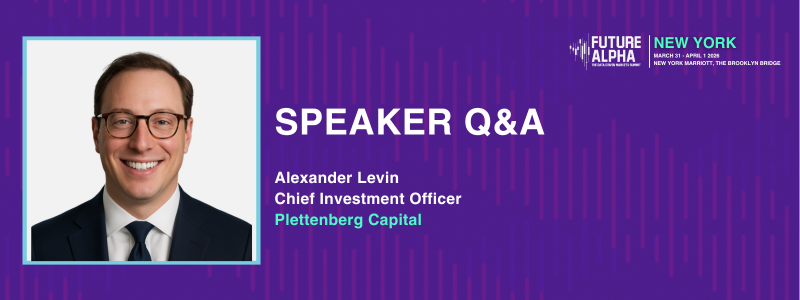
Speaker Q&A with Alexander Levin, Chief Investment Officer at Plettenberg Capital.
Future Alpha: Alexander, as CIO overseeing a broad public-markets platform, how do you think about integrating heterogeneous data—market, macro, sentiment, positioning—into a unified risk view that portfolio teams can actually act on?
Alexander Levin: At Plettenberg, we think of risk as the state of a system, not a single number.
A useful analogy is flying. You don’t fly a plane by staring at the fuel gauge. You fly with an instrument panel that shows altitude, speed, heading, engine health, and weather - and, crucially, warns you when you’re drifting into danger.
We unify very different data sources by doing three things.
First, we translate every input into the same question: what does this imply for forward risk? Market trend, breadth, positioning, volatility, macro stress, sentiment - everything is converted into comparable features that speak the same language.
Second, we separate conditions from forecasts. We don’t try to predict what markets will do next week. We focus on identifying the regime we’re likely in right now and what tends to happen historically when the system looks like this. That’s second-order thinking: less “what do I think?” and more “what does this setup usually lead to?”
Third, we tie the risk view to predefined actions. A dashboard that only says “risk is rising” isn’t very useful. Our framework maps states of the world to behavior: which exposures we cap, which strategy groups we scale down, and what needs to change before we re-risk.
The goal is a shared picture that’s simple enough to govern and clear enough to act on in real time.
Future Alpha: Given your oversight of multiple strategies, can you share an example where real-time monitoring prompted an immediate portfolio or exposure adjustment - and what that moment revealed about the strengths or gaps in current risk systems?
Alexander Levin: One of the most informative moments in portfolio management is when diversification stops behaving like diversification.
On paper, many portfolios look diversified. In practice, certain regimes cause correlations to spike and reveal that you were running one large, hidden bet.
We’ve had periods where real-time monitoring showed multiple strategy groups simultaneously approaching historical drawdown limits, cross-asset relationships tightening, and liquidity or volatility conditions shifting quickly. In those moments, the same positions carried more downside per unit of expected return than they did a few weeks earlier.
We reduced exposure not because we turned bearish, but because the environment changed. The system was telling us that the risk per dollar of exposure had increased.
What this revealed is that rules-based risk controls are most valuable when emotions are loud. Predefined drawdown and exposure rules prevent you from explaining your way into bigger risk.
It also reinforced that the biggest danger isn’t what you measure, but what you assume. Many failures come from carrying yesterday’s relationships into today’s regime. We treat regime shifts as core risk events, not statistical noise.
Future Alpha: Plettenberg manages exposures across diverse time horizons. How do you design risk engines that are transparent enough for governance but still sophisticated enough to capture cross-asset, non-linear, and regime-dependent sensitivities?
Alexander Levin: We design the risk engine the way you’d design a good legal contract: simple at the top, detailed underneath.
Governance requires clarity. People need to know the rules, when risk is reduced, and what happens when thresholds are hit. Trading, on the other hand, requires sophistication - non-linear payoffs, cross-asset effects, and regime dependence are real.
So we separate the system into two layers.
The first layer is a transparent constitution: exposure caps, diversification constraints, drawdown-based de-risking rules, operational kill-switches, and a clear escalation framework. This is the layer that can be explained cleanly to a risk committee.
The second layer is the engine room. This is where we model regime shifts, cross-asset sensitivities, stress transmission, and non-linear risk. It’s more complex, but it feeds into the simple rules above rather than overriding them.
In plain terms, decision-makers see the warning lights. The engineers see the diagnostics. Both matter, but they live at different levels of abstraction.
Future Alpha: Looking ahead, what’s the next evolution in firm-wide scenario and stress frameworks - particularly when we consider cross-asset shocks, behavioural overlays, and the challenge of translating trader intuition into scalable quantitative risk metrics?
Alexander Levin: The next step is moving from static stress tests to adaptive scenario systems that reflect how markets actually break.
Traditional stress tests often ask, “What if rates move 100 basis points?” Real markets ask, “What if rates move, liquidity dries up, correlations spike, and everyone de-risks at the same time?”
We’re focused on three advances.
First, modeling second-order effects. Not just the initial shock, but how it propagates: volatility increases, positioning unwinds, liquidity gaps widen, and correlations rise.
Second, incorporating behavioral effects in a measurable way. Concepts like crowding, panic, or capitulation sound qualitative, but they can be proxied using positioning, breadth, dispersion, volatility dynamics, and liquidity measures. The goal isn’t perfect precision, but directional accuracy when behavior starts to dominate fundamentals.
Third, translating researcher intuition into scalable metrics. Good intuition is pattern recognition. The risk is when it becomes narrative. In our research, we ask ourselves what we notice when conditions change, then convert those observations into testable proxies, and keep only what survives empirical validation.
Put simply, we’re trying to build stress systems that behave more like active fire drills than static museum exhibits.
Don’t miss Alexander on Day 1 at Future Alpha 2026 - 4:30 PM: Panel Discussion: Real-Time Risk in Motion: Architectures, Algorithms, and Trader Mindset, alongside Barclays Investment Bank, Waha Capital PJSC, and Quadriga Asset Management.