From DNA to Data: How PGIM Shapes Modern Quant Strategies
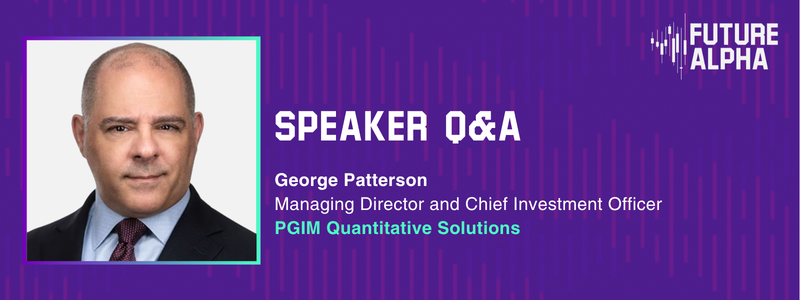
Speaker Q&A with George Patterson, Managing Director and Chief Investment Officer at PGIM Quantitative Solutions.
PGIM's Quantitative Solutions business traces its roots back to 1975, making it one of the earliest quant managers. When you look back at those origins, which elements of that original DNA still shape how the business thinks about quant investing today?
PGIM's Quantitative Solutions business has been a pioneer in systematic investing for nearly five decades, having just celebrated its 50th anniversary last year. From the very beginning, the group has been highly focused on innovation - an attribute that remains central to our approach today.
One early example of that innovative mindset was the team's adoption of flexible options based strategies in the mid 1990s, well ahead of much of the industry. That willingness to explore new tools and techniques in a disciplined, systematic way continues to shape our portfolio management approach and resonate with clients around the world.
At its core, the original DNA of the firm is still visible today. Most notably, you see it as we continue to leverage cutting edge research and proprietary technology to design innovative, practical solutions that help clients achieve their goals through increasingly complex global market environments.
How do you think of quant investing on behalf of institutional clients?
First and foremost, we are investors that use quantitative tools to improve our ability to capture investment beliefs. This is in contrast to many "black box" firms that rely on short-term statistical anomalies that are often subject to fast decay and may fail during periods of market stress.
Quant investing, as PGIM approaches it, begins with a deep understanding of long-term investment beliefs. In many ways, we attempt to capture many of the same insights that fundamental investors capture. The difference is that we can do it at scale and across numerous markets and geographies in a way that fundamental investors cannot. Our systematic approach also helps remove emotional bias while ensuring decisions are grounded in data.
Factor based analysis plays a critical role in this process. By examining factors across regions and asset classes, the team is able to anticipate trends, identify regional opportunities, and exploit market inefficiencies. This broad and flexible toolkit enables the discovery of new and diversified sources of return that may not be easily captured through traditional approaches.
An important distinction to make is that institutional clients typically view quant investing as a way to bring precision, risk control, and resilience into their portfolios. The goal is to deliver consistent, repeatable outcomes that help clients meet their long term portfolio objectives–it's not just about beating a benchmark.
Where does quant equity fit in client portfolios, practically?
In practice, allocators often use quant equity strategies as an active core allocation within their portfolios. These strategies are frequently paired with more concentrated fundamental managers, creating a complementary balance between systematic diversification and high conviction stock selection.
PGIM's Quantitative Solutions team builds proprietary stock selection and portfolio construction models designed to produce intuitive outcomes. Unlike firms that rely on off the shelf models, we deliberately avoid standardized frameworks in favor of proprietary approaches tailored to meet specific client needs. This customization allows portfolios to better address inefficiencies that can arise from generic models.
Custom solutions also make it possible to align risk controls more closely with client objectives. Because our investment process is systematic and transparent, we can tailor mandates without compromising the integrity of the underlying model. The result is a flexible, client centric approach that integrates seamlessly into broader portfolio structures.
How is technology changing what's possible in bespoke portfolio construction?
Advances in technology have significantly expanded what's possible in bespoke portfolio construction. One notable example is the use of tools such as Natural Language Processing (NLP), a subset of artificial intelligence. These tools allow the team to analyze earnings call transcripts and company commentaries across tens of thousands of stocks in our investable universe - essentially performing the work of a large team of analysts at scale.
While technology enables the team to work more efficiently, it's important to note that human expertise remains essential. Portfolio construction still requires experienced professionals to accurately identify client objectives, design the models that meet those needs, and conduct ongoing monitoring and testing. Technology enhances the process, but human judgment ensures the models operate effectively and remain aligned with client goals.
Which areas of innovation today feel as significant as the factor revolution was in earlier decades?
The rise of NLP and broader AI driven advancements stands out as one of the most meaningful areas of innovation today. These advancements are reshaping how data is collected, processed and interpreted at large.
At the same time, it's important that managers have robust guidelines around how - and how not - AI can be applied within the investment process. Innovation should enhance decision-making, while maintaining accountability, transparency and rigorous risk management. As such, firms should be cautious when considering emergent technologies like generative AI that are capable of making investment decisions without human oversight.