Decode the Market. Build the Future.Capture the Alpha.
Media Center
2026 Speaker Presentations
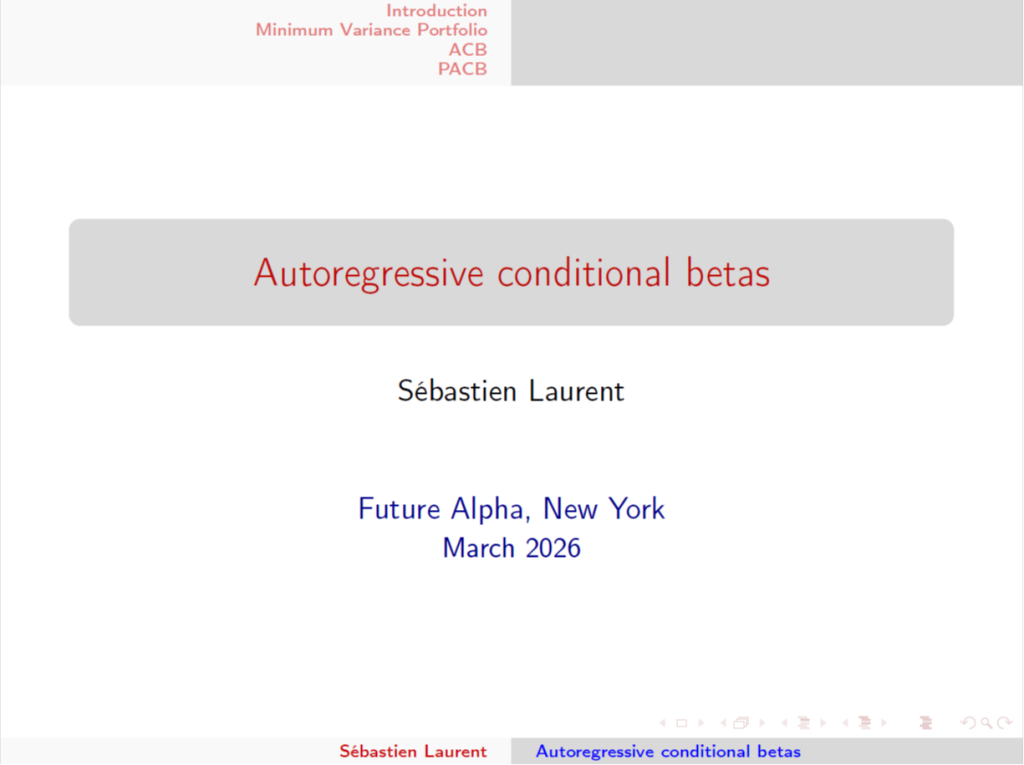
Precision Under Pressure - Rethinking Market Risk in a Volatile World
In this keynote, Sébastien Laurent draws on his deep expertise in econometrics to challenge the current state of volatility modelling and explore cutting-edge methodologies for assessing and forecasting conditional risk in complex portfolios.
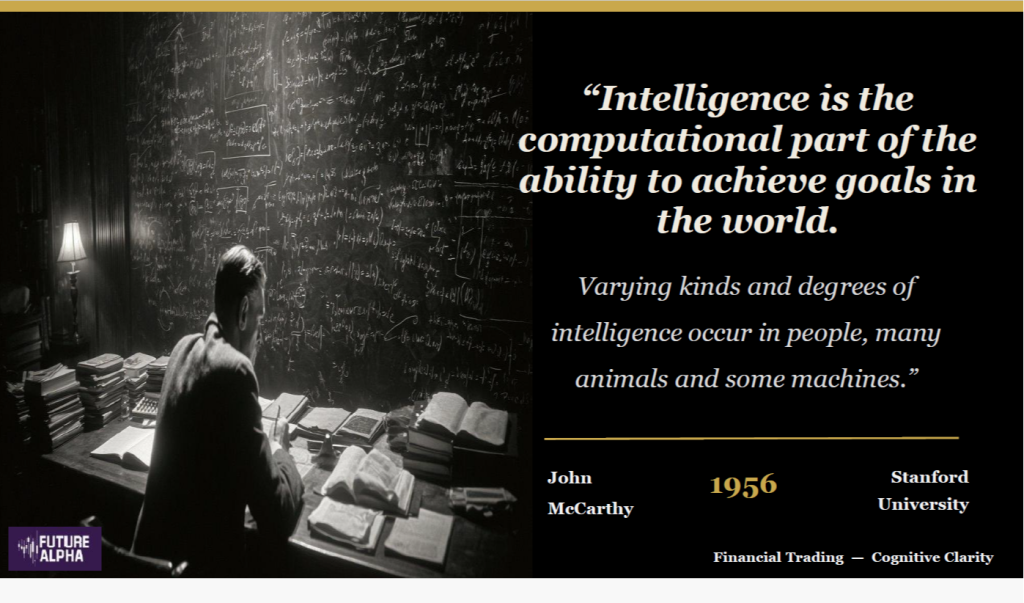
Financial Trading with cognitive clarity, technical realism and zero hype
Masterclass led by John Thomas Foxworthy, Founder, The Global Institute of Data Science.

How Should You Diversify? Evaluating Approaches to Systematic Portfolio Design
Why diversification matters in quant strategies: risk-adjusted returns, drawdown mitigation, robustness - Jacob Amaral, Head of Quantitative Research, CSCB Management.
Inside the Machine: How Man Group Architects its Technology Teams
Barry Fitzgerald, Co-Head of Front Office Engineering, Man Group.
What does good look like for Front-Office Engineering?
Alan Russel, Former Lead Quant Engineer - Head of Front Office Engineering, Brevan Howard.
Execution as a Source of Persistent Alpha: Optimal Execution, Market Integrity, and DeFi Manipulation Dynamics
In this keynote, Natascha Hey examines execution as a structural component of portfolio performance rather than a post-trade function. Her talk bridges traditional and decentralized markets, showing how market design, impact models, and transparency shape execution risk and alpha persistence.
This session provides a rigorous framework for understanding execution resilience and manipulation pathways in both regulated and on-chain environments.
Advanced Risk & Portfolio Analytics for Investment Firms
Zoubair Esseghaier, Head of Product, Risk & Performance, Clearwater Analytics.
Closing the Gap Why Quant Finance needs women and what we’re doing about it
This talk will explore how expanding access to high-income careers like quant finance is essential to tackling the global gender wage gap and how we're building that future through CLQ - Akshara Desai, Co-founder, Columbia Lioness Quantitative.
Intraday Signals from Market Microstructure
Intraday Signals from Market Microstructure - Yianni Gamvros, CEO and Co-Founder, Quantum Signals.
Multi-Period Portfolio Optimization with Discrete Decisions
Portfolio decisions are made repeatedly and each rebalancing is subject to transaction costs, turnover limits, and discrete asset selection constraints that affect future flexibility. Capturing these effects requires moving beyond single-period models to multi-period optimization. In this session, we demonstrate how multi-period portfolio problems can be formulated and solved as mixed-integer optimization models using Gurobi. We show how to model position dynamics across time, incorporate realistic discrete features such as cardinality constraints, transaction costs, and minimum trade sizes, and account for how these decisions interact across rebalancing periods in a backtesting setting. Because backtesting requires solving many related optimization problems, solver performance becomes a key practical consideration. We also share modeling best practices and practical insights for scaling multi-period mixed-integer models efficiently - Dr. Silke Horn, Senior Optimization Engineer, Gurobi.
Unlocking data-driven insights across securities lending and ETFs
New Securities Finance demand sentiment data, presented at the transaction level, enables users to track short position profitability and assess squeeze risks. The new Securities Finance inventory data delivers transparency into lending supply at the underlying fund level, providing unique insights into institutional fund flows and long positioning. Securities lending data can also be combined with ETF composition data to generate novel factor exposures for ETFs, whereby short sentiment at the ETF level can be calculated using a bottom-up approach. Aggregating short sentiment data at the ETF level can be used for systematic ETF portfolio construction. Together, these advances demonstrate how evolving datasets are driving new opportunities for quantitative strategies - Mark Klein, Executive Director, Head of Business Development - Equity Analytics Products S&P Global Market Intelligence.
From Scale to Signal The Need for Speed in Alpha Generation
Every quant team has a jet. But raw compute without high-throughput scheduling is like a fighter that can't break the sound barrier—all power, no speed. This talk is your call to the danger zone. We'll show how throughput-optimised architecture and massive concurrency punch through scheduling bottlenecks, orchestrate billions of tasks, compress research cycles from days to hours, and turn large-scale compute into the unfair advantage it was meant to be. Because when speed matters, only teams built for throughput get there first - Alan Parry, CTO, YellowDog.
The ROI in Iterative Thinking and Why Scrappy Quants Are Winning
Jonathan Kay, CEO and Founder, Apptopia Vadim Khidekel, Owner, Khidekel Quant Consulting.
Quantum-Inspired Alpha Generation A New Approach to Active-Passive Investing
Samuel Fernandez, Founder and CEO, InspirationQ.

From Months to Minutes Accelerating Alpha Generation with Tabular AI
In this session, we outline how this paradigm compresses research cycles: shifting time away from model optimization and toward signal exploration. We share benchmark results and workflow comparisons illustrating improvements in iteration speed, robustness across datasets, and faster feature testing. We also discuss how proprietary datasets can further enhance performance through co-training, enabling systematic teams to build differentiated models while retaining full control over their data and IP - Jeremy Ben Sadoun, CRO and founding member, Neuralk AI.
Harnessing the Power of Market Structure using NDX Options
David Pegler, Global Macro Strategist and Co-Founder, Tier1 Alpha and John Black, VP, Head of Index Options Sales, Nasdaq.
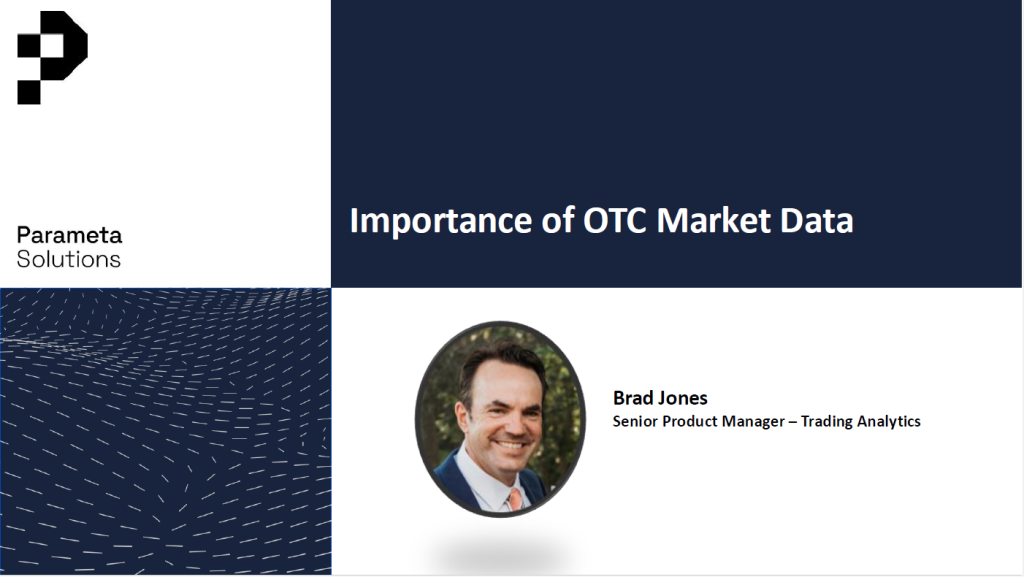
The Importance of OTC Market Data
Brad Jones, Senior Product Manager, Trading Analytics Parameta.
Alpha Without the Overhead Simplifying the Modern Quant Data Pipeline
Rob Glanzman, Global Strategic Alliances Principal Architect, Financial Services – Everpure.
Forward, Point-in-Time Corporate Events: Why They Matter for Every Trading Strategy
Anju Marempudi, Founder & CEO, EventVestor.
Fragmentation Kills Alpha
Didier Lopes, Founder and CEO, OpenBB.
The New Standard for Measuring Structured Product Risk
Amélie Labbé, Chief Product Officer, SRP.