From Equities to Everything: Judith Gu on Unlocking Alpha Across Asset Classes
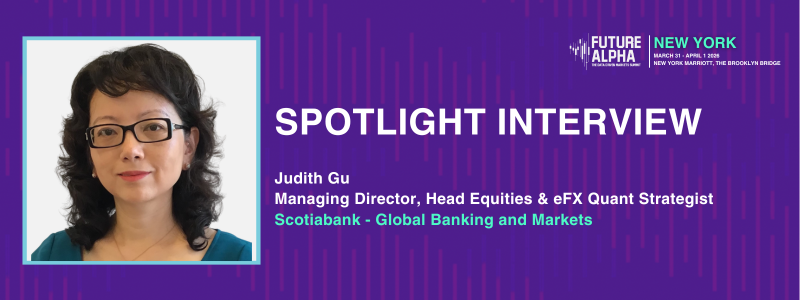
Spotlight Interview with Judith Gu, Managing Director, Head Equities & eFX Quant Strategist at Scotiabank - Global Banking and Markets.
Judith, you’ve spent your career extracting signal from equities. When you shift into a multi-asset lens, what’s one lesson from equities that does translate surprisingly well and one that absolutely doesn’t?
What translates well:
- Rigorous Data Quality & Causal Feature Discovery: The discipline of ensuring data is not just clean but truly modellable (i.e. data has structures) - checking for stationarity, using causal denoisers (EMA, Kalman filters), and focusing on features with genuine predictive power - is a lesson from equities that applies robustly to other asset classes. This approach, which emphasizes causal relationships over simple correlations, is foundational in both equities and multi-asset modeling.
- Feature Engineering & Selection: Techniques like rolling stability analysis, LASSO regression, and categorical screening (CatBoost) for robust feature selection are equally valuable when moving to FX, bonds, or crypto. The need to adapt features to the trading environment (e.g., session encoding, volatility clustering) is universal.
What doesn’t translate:
- Predictability of Returns: In equities, short-horizon returns often behave like white noise - unpredictable and lacking autocorrelation. This unpredictability is even more pronounced in FX and other asset classes, where market microstructure and liquidity cycles break the link between returns and volatility. The mathematical identity between returns and volatility holds in theory but not in short-term practice, especially intraday.
- Naive Correlation Assumptions: Simple correlations that sometimes work in equities (e.g., between returns and volatility) can be misleading in multi-asset contexts. Each asset class has unique drivers - order flow, news, liquidity regimes - that require tailored modeling approaches.
In your view, what’s the most underestimated challenge in building infrastructure that truly supports cross-asset signal integration and what’s one design choice you think more firms should be making?
Most underestimated challenge:
- Data Reliability & Causal Consistency: The biggest challenge is not just cleaning data but ensuring it is causally consistent and suitable for modeling across assets. This means going beyond surface-level accuracy to validate that features drive real market behavior, not just spurious correlations. Causal denoising, robust validation pipelines, and feature engineering that reflects real trading environments (latency, session tags, volatility) are critical.
- Production-Grade Controls: Ensuring research findings translate into production requires persistent feature engineering logic, replay/shadow mode testing, and continuous monitoring for drift and causality violations.
Design choice more firms should make:
- Session-Aware & Regime-Aware Modeling: Infrastructure should support session encoding (Asia, London, NY overlaps), regime-aware volatility features, and adaptive pipelines that recalibrate in real time. This enables models to adjust dynamically as market rhythms change, which is essential for cross-asset integration.
- Explainability & Governance: Embedding explainability (e.g., SHAP values, causal feature selection) and governance protocols ensures models are robust, auditable, and compliant with regulatory standards.
Alpha decay is a universal challenge, but it behaves differently across asset classes. How do you think about detecting decay early in equities, and how does that intuition shift when looking at FX ?
Detecting decay in equities:
- Rolling Stability & Out-of-Sample Validation: Use rolling stability analysis to monitor feature persistence and predictive power over time. Cross-validation across different market regimes and stress-testing against volatility conditions help catch early signs of alpha decay.
- Ensemble & Shadow Mode Testing: Running ensemble models and shadow mode testing (parallel research and production models) helps catch drift and validate robustness in live trading.
Intuition shift for FX:
- Regime Detection & Session Awareness: In FX, regime changes and session overlaps (Asia/London/NY) drive volatility and alpha decay. Models must recalibrate intraday and use regime-aware features to adapt to shifting liquidity and volatility profiles.
- Causal Feature Discovery: In these markets, causal discovery algorithms (PCMCI, causal graphs) are helpful, if can be identified, to distinguish true drivers from artifacts, especially as market structure and participant behavior differ from equities.
Looking ahead, as systematic teams integrate signals across more asset classes, where do you see the biggest opportunity for diversification that’s still underutilized and what’s holding the industry back from capturing it?
Biggest opportunity:
- Session & Regime-Based Diversification: Leveraging session-aware modeling and regime-aware volatility features enables teams to capture diversification benefits that are often missed when signals are aggregated without regard to market structure. For example, FX and equities trade in overlapping sessions with distinct liquidity and volatility profiles - models that adapt to these can unlock new sources of alpha.
- Alternative Data & Causal Signals: Incorporating alternative data (news sentiment, event-driven signals, real time dislocations cross correlated markets) and focusing on causal rather than correlative relationships can provide orthogonal sources of diversification.
What’s holding the industry back:
- Infrastructure & Validation Gaps: Lacking the infrastructure for real-time calibration, session-aware modeling, and robust validation pipelines. Without these, research often fails to translate into production, and models cannot adapt quickly enough to regime shifts.
- Overreliance on Historical Correlations: The tendency to rely on historical correlations and static models limits the ability to capture dynamic diversification opportunities. Embracing causal inference, regime detection, and adaptive pipelines is necessary to overcome this.
Don’t miss Judith on Day 1 of Future Alpha 2026 at 11:40 AM, speaking on the panel: Multi-Asset Alpha – Signal Integration Across Equities, Bonds, FX & Crypto.