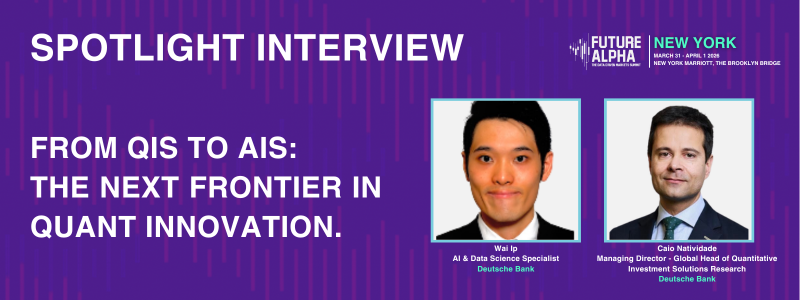
From QIS to AIS: The Next Frontier in Quant Innovation.
Agentic Investment Solutions (AIS) represents a transformative shift in the evolution of quantitative investing. For decades, quantitative research has focused heavily on methodologies and data for alpha seeking and mitigating alpha decay. In this new era, driven by the proliferation of language models and agentic solutions, the competitive edge will no longer hinge solely on models or datasets; it will be defined by intelligence architecture instead.
The typical strategy development pipeline is filled with manual processes, which are often too arbitrary and time-consuming. From literature review and data preparation to backtesting and deployment, the process often spans several months and is further complicated by quality control challenges. The future, which will be heavily assisted by agentic workflows, should see a significant compression in the R&D lifecycle as we unlock new levels of productivity, quality, and adaptability.
The question is, how do we go about it?
Empowering Research with RAG and Layered Architecture
First, we must embrace agentic Retrieval-Augmented Generation (RAG) in our R&D. Sitting at the top of our book of work, a RAG-based framework forms an agile bridge between users, intellectual property, and desired output. By grounding generative AI in constantly evolving knowledge bases, it turns vast repositories of documents, datasets, and codebases into actionable intelligence. It enables intelligent search, contextual understanding, and automated execution, empowering agents to operate as collaborative problem-solvers rather than static tools.
Second, the research blueprint must be (re)designed using layers. This includes, for instance, a knowledge base for holding document embeddings, datasets and code repositories, all linked to an additional data interface layer. We would then add an agentic interface layer that hosts specialised agents equipped with protocols and guidance for interaction. Finally, we would add a main pipeline layer that orchestrates information and processes user requests, and is designed in such a way that ensures governance and workflow integrity. Such architecture is intentionally built for scale.
A Holistic Evaluation Framework
The key to success will be about accurate information flow, which we seek to achieve through specialization and context engineering. While it is tempting to imagine a world of task-specific agents – such as a risk agent or a portfolio agent – the real differentiator will come from guiding message generation and tuning LLM responses.
Such controls – which comprise a holistic evaluation framework – will help prevent errors from hallucination, context rot or faulty function calls that ultimately propagate and amplify risk. This is because, unlike programming, which builds deterministic logic, agentic systems operate in collaborative chains where outputs are probabilistic and therefore more prone to error.
An AI Cookbook
AIS is not just about adding AI. It is also about creating a cookbook for the investment process, so that the automation process is best guided. Consolidation and semantic enrichment are transformative. In recognition of that, our team has spent years building centralized data infrastructure and code repositories, all enriched with metadata and documentation. Meanwhile, we are also establishing data cataloguing and vendor onboarding pipelines. These foundations will ultimately enable seamless access for agents to retrieve insights, locate relevant datasets, and accelerate strategy development, paving the way for scalable AI transformation.
Vibe Research is the New Normal
Finally, we must embrace vibe research practices. With AI, research may no longer be a marathon as analysts will be able to iterate ideas rapidly, access data instantly, and build code in a snap. This is vibe research – fast, fluid, and exploratory. It will soon become the new normal, and a robust, scalable, agentic ecosystem will be the cornerstone for sustaining innovation and responsiveness in the quantitative investment space. It will ultimately define the leaders in our field.
Assumptions, estimates and opinions expressed constitute the author’s judgment as of the date of this communication and are subject to change without notice. Past performance is not necessarily indicative of future results. This communication is based upon information that Deutsche Bank or one of its affiliates (collectively "Deutsche Bank") considers reliable as of the date hereof, but Deutsche Bank does not represent that it is accurate and complete. Deutsche Bank does not render legal or tax advice, and the information contained in this communication should not be regarded as such.