Petter Kolm on What AI/ML Can Really Do for Systematic Investing
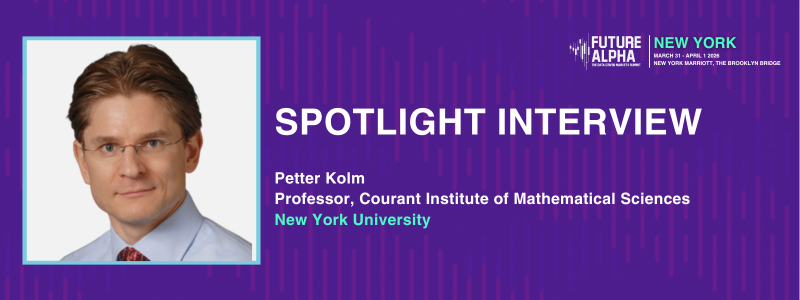
Speaker Q&A with Petter Kolm, Professor, Courant Institute of Mathematical Sciences at New York University.
Future Alpha: Petter, machine learning has made real progress in short- and medium-term forecasting, but where do you see the mathematical breakthroughs that are actually moving the needle in return prediction, volatility modelling, or regime detection?
Petter Kolm: The most meaningful advances are coming not from deeper architectures, but from better problem formulation - models that explicitly recognize that markets are noisy, adaptive, and subject to structural breaks.
First, regime-aware modelling has become essential. Markets are fundamentally non-stationary, and latent-state or regime-switching approaches produce more reliable signals because they adjust as conditions shift.
Second, microstructure-informed volatility models connect risk forecasts to order flow, liquidity, and impact. Incorporating these dynamics - often through state-space or Hawkes-type structures - yields volatility estimates that hold up better out of sample.
Third, we’re seeing real progress in learning under frictions: embedding costs, turnover, capacity, and impact directly into the objective rather than adding them after the fact. When models are built around actual trading constraints, their predictions are far more likely to translate into usable alpha.
In short, the breakthroughs that matter are structural and economic, not architectural. The aim is not just prediction accuracy, but robustness to how markets actually behave.
Future Alpha: When integrating predictive models into allocation decisions, how should investors balance theoretical optimality with execution realities like slippage, liquidity constraints, and capacity?
Petter Kolm: “Optimal” in a frictionless model rarely survives contact with the market. A practical approach has three main components.
First, convert forecasts into friction-adjusted expected returns. Liquidity, nonlinear impact, and capacity fundamentally change how a signal should be evaluated. Many signals disappear once these are incorporated.
Second, consider using multi-period portfolio construction. One-shot optimizers tend to overtrade. Dynamic methods - model predictive control, execution-aware LQR, and RL-inspired approaches - naturally balance alpha decay against transaction costs and impact.
Third, strengthen the link between research and execution. Execution quality is part of the model, not an afterthought. Adaptive participation, smart order routing, and liquidity-sensitive scheduling all shape how much of a forecast becomes realized alpha.
Future Alpha: Unstructured data continues to grow exponentially. What approaches are most effective for turning text - earnings calls, filings, news - into stable, investable signals rather than transient noise?
Petter Kolm: The main challenge is avoiding signals that simply capture short-lived sentiment. The approaches that work tend to share three elements.
First, robust semantic representations. Transformer-based embeddings stabilize meaning and dampen idiosyncratic phrasing, producing features that hold up across time and regimes.
Second, context and normalization. Text becomes informative only when compared to a company’s own history, its peers, and the broader market tone. Cross-sectional and time-series normalization strips away macro mood and highlights firm-specific information.
Third, economic framing. Durable signals come from text features tied to fundamentals - changes in guidance, valuations, risk disclosures, or uncertainty - not generic “positivity.”
Future Alpha: With so many AI choices - traditional ML, deep learning, LLMs, agentic systems - how should investors decide when a simple model is sufficient versus when a more complex architecture is justified?
Petter Kolm: One of the biggest pitfalls today is overconfidence in complexity. Success in images or language doesn’t guarantee success in financial markets, where data is noisy, non-stationary, and adversarial.
My framework is straightforward:
- When the economics are well understood and the feature space is modest, start simple - regularized linear or generalized linear models often outperform more complex ones out of sample.
- When you have evidence of nonlinear interactions, consider tree-based methods, boosting, or moderate-depth networks.
- When the input itself is complex - such as text, audio, graphs - more elaborate architectures like transformers may be justified.
We should remember that models are increasingly commoditized. State-of-the-art architectures and pretrained components are widely available. The edge lies in data quality, domain expertise, and disciplined research and validation workflows. That’s where investors should focus their effort.
Future Alpha: Organizational readiness often determines success more than technology. What cultural or workflow changes must firms make before machine learning can meaningfully shape portfolio construction and execution?
Petter Kolm: In practice, technology is rarely the bottleneck. The real differentiators are almost always culture, governance, and workflow.
Success tends to come from organizations that have:
- Cross-disciplinary research cultures, where data engineers, quants, PMs, and risk managers operate as a single team.
- Disciplined research governance - version control, experiment tracking, reproducibility standards, and rigorous validation.
- Integrated data–model–execution pipelines that ensure signals flow seamlessly from research to trading.
- Human-in-the-loop oversight, especially during regime shifts or market stress. AI/ML doesn’t replace judgment; it reshapes how judgment is applied.
- Aligned incentives and realistic expectations. ML thrives in stable, process-driven environments - not in organizations looking for quick wins.
ML becomes truly impactful when it is embedded in how the firm operates, not when it is treated as a standalone initiative.
Future Alpha: And finally - what do you think AI/ML can realistically solve in finance today?
Petter Kolm: AI/ML excels at uncovering structure in high-dimensional data, supporting adaptive execution, identifying market regimes, and accelerating research workflows - from code generation to diagnostic analysis.
It struggles with causality, feedback effects, and robustness under large distribution shifts - precisely where financial systems are most fragile.
For me, the real AI/ML revolution in finance is the shift toward more disciplined, transparent, and scalable research. These tools extend human capability; they don’t replace it. The greatest value comes from enabling practitioners to understand and navigate complex markets with more clarity and speed.
Don’t miss Petter at Future Alpha 2026.