Q&A: Berenberg's Oliver Scharping on the Future of Alpha
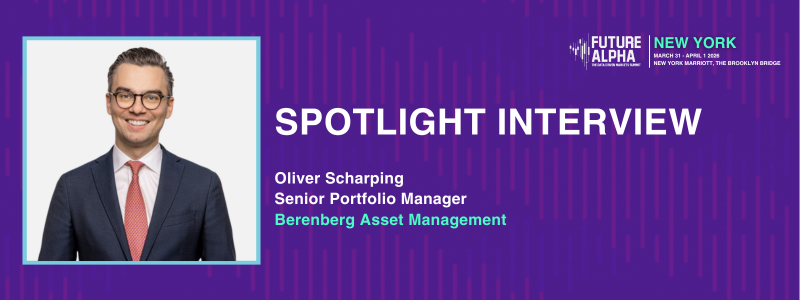
Spotlight Interview with Oliver Scharping, Senior Portfolio Manager at Berenberg Asset Management.
Markets are increasingly shaped by algorithms and AI-driven automation. Where do you believe 'old-school' discretionary traders still hold a structural or behavioural edge over systematic strategies?
In my view, the edge for discretionary traders has migrated to what I call "Strategic Alpha". While algorithms excel at "Analytical Alpha" - processing vast datasets and identifying patterns - they often struggle with judgment under ambiguity. A discretionary trader’s edge now lies in synthesis and relationship capital, particularly in complex situations where data is sparse or context is king. For instance, in merger arbitrage, an algorithm might calculate a probability based on spread and volume, but a human is better equipped to assess the credibility of management or the nuance of a regulatory shift that has no historical precedent. That judgment is why, even in a tech-heavy world, we’ve been able to consistently uncover alpha in special situations that the models flagged as 'too risky' or 'uninvestable'.
Quant models excel at processing data but often lack intuition. How can we translate elements like market feel, flow awareness, and pattern recognition into investing frameworks without overfitting or losing nuance?
We shouldn't try to codify "market feel" entirely. I’ve spent the last few years specifically architecting workflows that bridge this gap. The goal is "Augmentation" - using AI to handle the heavy lifting of "Operational" and "Analytical" tasks so the human can focus on the nuance. At Berenberg, we use GenAI for document intelligence to compress hours of reading into minutes, extracting structured data from deal agreements. We also use quantitative models to predict deal completion probabilities with high accuracy. However, we treat these as inputs, not decisions. The model provides a signal, and the PM overlays their judgment to capture the nuance the model might miss, effectively acting as a "pilot" to the AI's "co-pilot".
During periods of dislocation - whether geopolitical shocks, liquidity fractures, or policy surprises - which tends to prove more resilient: quant-driven or discretionary approaches? And what explains that resilience?
Discretionary approaches tend to be more resilient during true regime shifts because AI and quant models often stumble on "Real-Time Adaptation". Most systematic strategies rely on trained data; when a geopolitical shock creates a scenario that doesn't statistically resemble the past, models can fail to adapt or hallucinate patterns. We found that while AI is excellent at pattern recognition, it struggles with "Regime change response". Human judgment under uncertainty is the ultimate risk management tool in these moments because it allows for reasoning by analogy and context, rather than just historical correlation.
There’s ongoing debate about fundamental traders versus quants. Do you see the future of market edge as competitive between the two disciplines, or increasingly collaborative, with hybrid models becoming the norm?
It is not a winner-take-all competition; it is a "Redistribution" of alpha among three categories: Operational, Analytical, and Strategic. The near future belongs to the "AI-Augmented PM" who collaborates across these layers. If you view it as competitive, you lose. Quants own the "Analytical Alpha" (predictive modeling), while infrastructure providers (like our partners at Google) own "Operational Alpha" (workflow automation). The fundamental trader’s role is to leverage both to maximize their own "Strategic Alpha". Of course, looking ten years out, if we achieve true superintelligence, the board might change entirely - but for the investable horizon, the most successful teams will be those that stop fighting the machines and start managing them.
If you could redesign the ideal investment team for the next decade, what balance of discretionary insight, quantitative research, technology, and data infrastructure would it include and why?
The ideal team mirrors the "Three Layers of Alpha" framework I advocate for. First, you need strong "Operational Alpha" capabilities - automated plumbing for data processing and compliance. Second, you need internal quant resources to build "Analytical Alpha" tools - proprietary signals and probability models. Finally, the core decision-makers must be discretionary PMs who are "AI-native" - capable of synthesizing these inputs to generate "Strategic Alpha". This is why I emphasize teaching my university students and analysts prompt engineering alongside financial modeling - you need a culture shift, not just a tech shift. This structure ensures you aren't paying humans to do robot work, but rather freeing them to focus purely on high-value judgment.
Join Oliver on Day 1 at Future Alpha 2026 for his 3PM Fireside chat, “Discretion vs. Data: Traders, Quants, and the Future of Market Edge.”