Beyond the Buzz: How AI Actually Helps Investment Teams Make Decisions
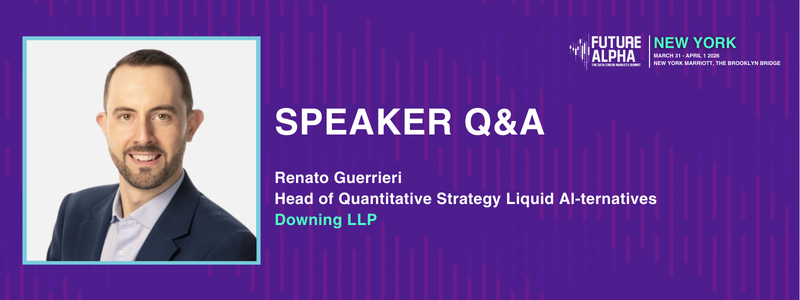
Speaker Q&A with Renato Guerrieri, Head of Quantitative Strategy Liquid Al-ternatives at Downing LLP.
There’s a lot of hype around AI in asset management. Where do you see real value today versus aspiration?
The real value today is not automation or prediction. It’s improving how investment teams process information and make decisions under uncertainty. AI already adds value when it helps synthetise large information sets, surface inconsistencies, stress-test narratives, and improve internal communication around risk and conviction. What remains largely aspirational in the medium term is end-to-end automation of investment decisions. That vision underestimates how much judgment, context, and accountability sit around capital allocation. In practice, progress is often slower because firms discover that the hard work is not the model. It’s data quality, workflow integration, governance, and making outputs usable by humans. Until those foundations are in place, the impact will likely remain incremental rather than transformational.
From your experience, what actually limits the usefulness of LLMs in investment teams?
The limiting factor is almost never the model itself. It’s context. LLMs perform poorly when they’re fed raw data, unstructured outputs, or asked to generate conclusions in isolation. They perform much better when they sit on top of deterministic, pre-computed metrics and are placed in a clear analytical frame. Another constraint is integration. If LLMs live outside the environments analysts and PMs already use, they become novelty tools rather than decision support. Finally, misuse is common. Treating LLMs as forecasting engines or trade generators can undermine results and trust. Used correctly, they are best at explanation, comparison, and challenge, rather than replacing judgment.
How should firms think about using advanced analytics tools without weakening accountability or investment discipline?
Accountability has to remain explicit. Tools should support decision-making, not obscure it. The moment responsibility becomes blurred between humans and systems, both discipline and adoption suffer. Advanced analytics work best when they are used to clarify assumptions, explore scenarios, and document reasoning, especially at IC level. They should make it easier to explain why a position exists, what could challenge it, and how risk is being managed. When framed that way, these tools actually strengthen governance and investment discipline rather than undermine it. Ownership stays with the decision-maker, while the quality of the decision process improves.
Cost and infrastructure often come up as blockers. Why are they such a bottleneck across AI, ML, and compute-heavy investment processes?
Because the costs are real and front-loaded. Centralised compute, data engineering, security, and maintenance require upfront investment before value is fully visible. That’s true for LLMs, traditional ML, large-scale simulations, and compute-intensive models such as option pricing or risk engines. Many investment organisations underestimate this and assume the challenge is purely analytical. In reality, it’s architectural. Without a clear link to improved decision quality or operational efficiency, it’s often difficult to justify sustained spend. That’s why adoption tends to be slower and more selective than the external narrative suggests.
Why does integration into day-to-day workflows matter more than model sophistication?
Because adoption follows convenience and trust, not theoretical capability. If advanced tools sit outside the core analytical workflow, they create friction and are easily bypassed. The most effective systems are those that embed advanced analytics directly into the environments where decisions are already made, whether that’s research platforms, risk dashboards, or IC materials. Model sophistication matters, but only after integration is solved. A simpler model in the right place will often outperform a more advanced one that lives in isolation.
Looking forward, what will differentiate firms that actually succeed with AI, ML, and advanced computing over the next decade?
The winners won’t necessarily be the firms with the largest models. They’ll be the ones that build robust infrastructure to ingest, process, and surface context-rich data from many sources in a way humans can actually use. Fully automated investment processes, allocators, and investment committees are not a realistic end state. Judgment, debate, and accountability aren’t going away. What will persist is the need for natural-language access to complex, data-intensive frameworks that help teams reason better and faster. Firms that combine strong engineering with clear decision ownership and pragmatic governance are more likely to compound an advantage over time.
Join Renato on Day 2 of Future Alpha 2026 at 11.20 AM for an insightful panel discussion: Practical AI applications in finance, including LLM workflows.