
How Buy-Side Firms Hire for Impact: A Q&A with Camber Morris
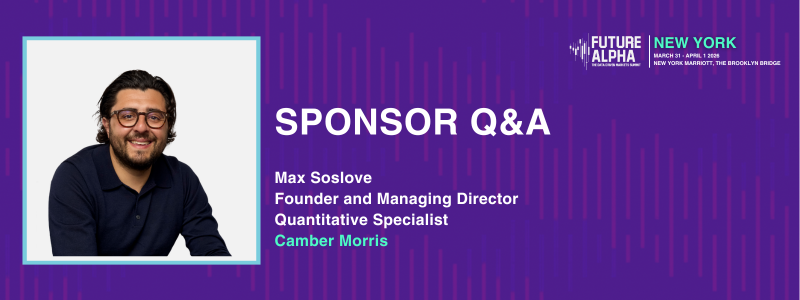
Sponsor Spotlight Interview with Camber Morris: How Buy-Side Firms Hire for Impact
When buy-side firms think about hiring, they often say they want “long-term contributors.” From your vantage point, what actually signals long-term value at the hiring stage, and what do firms often realise too late after someone joins?
That is a great question. Long-term contributors, in the simplest sense, are individuals who add multi-faceted value, or who deliver value across integral growth initiatives with multiple beneficiaries; such as building a centralised system used by multiple PMs or rebuilding tooling for a specific pod.
At the hiring stage, demonstrated experience doing this at peer or competitor firms is extremely attractive and warrants a deep technical and experiential dive. What funds want to avoid are candidates who sit on the periphery without deep ownership or expertise, but who may initially appear impactful without having delivered sustained, material value.
We hear a lot about skills shortages, but less about skills misalignment. Where do you see the biggest gaps between what candidates are trained for and what buy-side firms truly need in production environments?
So there are few areas to dive into here, the biggest gap is often between what candidates think firms want and what actually exists in production environments. Skills are highly transferable, and many funds increasingly prefer candidates with breadth of experience rather than a single narrow specialism.
The real value exchange lies in a combination of coding ability, financial product knowledge, and obviously, the ability to identify and express alpha. From a production perspective, an engineering mindset and the ability to build systems from a low level of abstraction are qualities that the most performance-oriented teams actively seek. This goes beyond candidates who can quote theory or rely heavily on templated software. Strong engineers tend to be technology-agnostic and capable of building robust systems from the ground up.
Across the buy side more broadly, what do top-performing investment teams look for when they are hiring today, and how does that differ from even a few years ago?
The combination of development and modelling expertise has become critical, particularly within pod-based structures. PMs increasingly expect candidates to have front-end tooling knowledge, portfolio construction experience, and exposure to pricing and analytics.
Additionally, the impact of AI is now material. Candidates with experience in agentic systems and LLMs are well positioned to form the next generation of quantitative talent, and this skill set is increasingly differentiated compared to even a few years ago.
How should investment firms be thinking about career paths for quants and technical talent, particularly when progression does not always mean people management? What does a strong long-term model look like?
There are two primary long-term pathways:
- Centralised teams across pricing, alpha research, and AI. This model is increasingly valuable due to reduced duplication of resources, better utilisation of firm-wide data, and the provision of a core platform supporting multiple PMs. These are long-term, evolving initiatives where individuals can build entire careers, either through hybrid skill sets or complementary specialist teams.
- Pod-aligned roles, where individuals work directly with a PM team. This pathway offers clearer accountability, direct impact, and closer exposure to revenue generation.
Looking ahead three to five years, what will distinguish firms that consistently attract elite quant talent from those that struggle? Are there cultural or structural shifts you think are now non-negotiable?
Well, trends from the past five years are likely to persist over the next three to five, particularly around the balance of remote and in-office work. Culture remains critical, but for many quants, compensation is equally important. Work-life balance has become a clear priority and is now regularly raised as an expectation during interviews.
Broadly speaking, candidates are increasingly motivated by more than just the firm name or job title. Leading firms are becoming more explicit about the actual projects, problem sets, and technical challenges candidates will work on, both through content and deeper interview processes. Transparency around compensation structures and bonus linkage remains a key differentiator, as it always has been.
For candidates navigating a crowded and competitive market, what are the most common mistakes you see on CVs or in interviews, and one practical change they could make immediately to stand out?
CVs: Candidates should clearly demonstrate ownership and impact. Using action-oriented language such as designed, implemented, modelled, and built stands out far more than relying on excessive buzzwords. While role-dependent, this hands-on framing is crucial.
Interviews: The most common mistake is listing experience that candidates cannot discuss in depth. If something appears on your CV, you must be able to explain what you did, why you did it, and how well you understand it. The clearer and more detailed your explanations, the stronger the outcome.
Don't miss Camber Morris at Future Alpha 2026, March 31 – April 1. Secure your pass today!