Inside a Generative Macro Fund: AI, Judgment, and the Investment Process
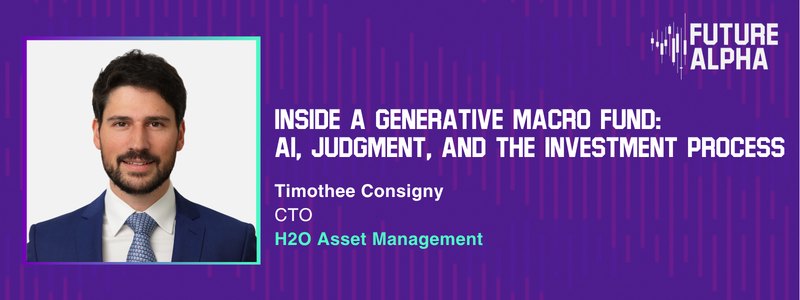
Q&A with Timothee Consigny, CTO at H2O Asset Management.
Your Generative Global Macro Fund integrates generative AI into a discretionary macro investment process. What gap in traditional macro investing were you aiming to address when developing this approach?
The core challenge in discretionary macro is not access to information. It is that alpha depends on the expertise and experience of portfolio managers, and portfolio managers are human: they have blind spots, biases and emotional constraints. Our objective was to use generative AI not to replace judgment, but to challenge it more objectively and to better understand both market narratives and our own internal ones.
One of the tools you've introduced is The Sensor. How does this influence the way your team interprets external research and builds macro views compared with more traditional research workflows?
The Sensor is built on external market research, but not on the idea that bigger is always better. Instead of feeding it the largest possible dataset, we use a smaller dataset curated manually by our portfolio managers. The point is not to summarise documents faster. It is to make sure we do not miss important details, and to help us analyse how consensus and divergence evolve across research sources.
You've also developed The Mirror, which focuses on analysing internal investment discussions. What role does it play in shaping the way your team debates ideas and challenges investment convictions?
The Mirror is based on transcripts of our internal investment meetings. By analysing how portfolio managers discuss market developments, positions, risks and convictions, it helps us identify patterns that matter in discretionary investing: repeated narratives, weak challenge, confirmation bias or loss aversion. Its role is to make internal debate more explicit and easier to revisit.
Behavioural bias is a long-standing issue in discretionary investing. To what extent can tools like Mirror realistically help investment teams recognise and manage those biases?
It is not a perfect solution, and it would be wrong to present it as one. But it helps in two ways. First, The Mirror makes certain behavioural patterns easier to identify after the fact. Second, thanks to the observer effect, the simple fact that discussions may later be reviewed tends to improve discipline during the discussion itself. That does not remove bias, but it can reduce some of its most obvious forms.
You've described the strategy as remaining fully discretionary despite the use of AI tools such as The Sensor and The Mirror. How do you think about the balance between AI-generated insights and human judgment in portfolio management?
For us, AI is not there to give better answers. It is there to make sure we ask better questions. The Sensor and The Mirror are there to challenge, structure and enrich the decision-making process. But portfolio managers must still form their own views, draw their own conclusions and make their own investment decisions. That is by design.
Across the industry, asset managers are exploring how AI can be integrated into investment processes. Do you think macro and multi-asset strategies are particularly well suited to this kind of technology?
Yes, but there is no single model. Some firms are trying to build more systematic or agentic approaches. Others still do not want to use AI directly in investment processes. Macro and multi-asset are well suited to it because they require you to process a wide range of unstructured information, narratives and cross-asset relationships. But the key is not to do AI for the sake of AI. The key is to embed it into existing, proven processes in a way that genuinely adds value.
Looking ahead, what should investors expect from the integration of tools like The Sensor and The Mirror into macro investing - and where do you see the biggest potential impact on how investment decisions are made?
AI is not going to magically double your Sharpe ratio or create uncorrelated alpha. In fact, it can become a real risk if portfolio managers stop reflecting, stop reading full documents and stop forming their own opinions because AI appears to have done the work for them. But used intelligently, The Sensor and The Mirror can help you fight one of your worst enemies in discretionary investing: yourself.