The Warsh Fed: Thinking through rates and beyond

Chairman Warsh has promised to be an agent of change at the Federal Reserve, seeking to streamline communications and advance institutional reforms through a series of task-forces. These efforts come amid still elevated inflation and an administration focused on lowering borrowing costs across the curve. In this changing policy landscape, we examine how to think about the Fed and, when everything appears to matter, what matters most.
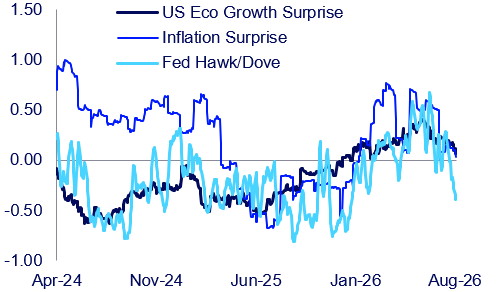
The immediate: The most immediate question for markets is when the Federal Reserve will next adjust rates. While U.S. economic data remain far from weak, growth has moderated and two consecutive soft CPI prints have given the Warsh Fed cover to pause. As a result, measures of Fed speaker tone have shifted from net hawkish to net dovish over the past two months (Figure 1).
Figure 1: Data slow down bolsters doves
Source: State Street Markets, MKT MediaStats
However, this dovish respite is unlikely to last indefinitely. Importantly, the shift has not been driven by Chairman Warsh himself. While broader interpretations of Fed communication have become more dovish, coverage of Warsh has remained consistently hawkish. When a large divergence emerges between perceptions of the Chair and the broader Committee, history suggests the rest of the Fed often shifts in a more hawkish direction to close the gap. With the current divergence ranking in the top 1% of observations since 2015, it would be difficult for the Fed to remain this degree of net dovish.
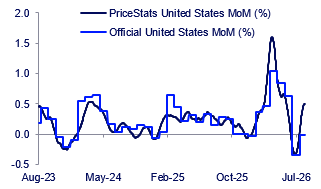
Adding to this, State Street's daily measures of online inflation suggest price pressures rebounded in August. Data through August 22 indicate that online prices rose an average of 37bps during the month, well above the historical average increase of 12bps. The more important question, however, is how broad-based these gains have been. Sector-level data point to underlying firmness, with household equipment, electronics and recreational goods all recording stronger-than-normal price increases. While this has been partially offset by softer trends in categories such as apparel, the broader picture suggests inflation remains sticky in key components of the core basket. That should place a floor under how dovish the Fed can become in the near term.
Figure 2: Not out of the woods when it comes to inflation
Source: State Street Markets, State Street PriceStats
Framing the bigger questions: Chairman Warsh has made clear his ambition to be a driver of change. With five task forces spanning Fed communications, balance sheet policy, data sourcing, productivity and workforce transformation, and the inflation framework, investors will have no shortage of developments to assess when evaluating the future reaction function and transmission of policy.
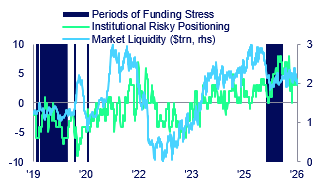
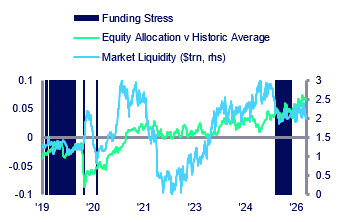
Each of these areas matters. Changes in Fed communications, for example, could meaningfully affect front-end volatility. However, one of the most consequential questions concerns the balance sheet. The size and composition of the Fed's balance sheet influence the cost of short-term funding, overall market liquidity, and ultimately financial conditions. As liquidity declines, institutional investors often reduce risk exposure, creating a powerful transmission channel from balance sheet policy to asset markets (Figure 3).
Figure 3 - Liquidity matters for risk appetite
Source: State Street Markets, Bloomberg
Figure 4 - Funding matters for equity exposure
Source: State Street Markets, Bloomberg
Importantly, a reduction in liquidity does not automatically trigger a wholesale exit from equities. Historically, more significant drawdowns in risk assets have occurred when funding conditions become stressed, illustrated by the navy bars above. We define such periods as episodes when SOFR trades above IORB.
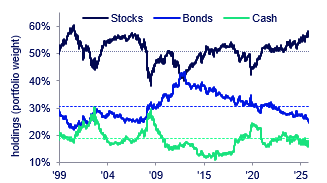
This is particularly relevant given current positioning. State Street's Investor Behaviour data, which leverages aggregated real-money custody data, indicate that institutional investors' equity allocations are nearly seven percentage points above their average over the past three decades (Figure 5). With investors already heavily exposed to equities, understanding how market liquidity evolves under a changing Fed may prove critical for asset allocators and portfolio managers alike. The interaction between balance sheet policy, funding markets, and investor positioning could ultimately be more important than the path of policy rates themselves.
Fugure 5 - Equity exposure is well above average
Source: State Street Markets
Disclaimers and Important Risk Information [2026.01]
This communication is provided only to professional clients or eligible counterparties or their equivalent by State Street Bank and Trust Company or, where applicable and permissible, its bank and non-bank affiliates ("State Street"). State Street Bank and Trust Company is authorized and regulated by the Federal Reserve Board, registered with the Commodity Futures Trading Commission as a Swap Dealer, and is a member of the National Futures Association. State Street Bank International GmbH ("SSBI") is regulated by the European Central Bank ("ECB"), the German Federal Financial Supervisory Authority ("BaFin") and the Deutsche Bundesbank. Details about the extent of SSBI's regulation by the ECB, the BaFin and Deutsche Bundesbank are available from us on request. Products and services described herein may not be available in all jurisdictions or through all State Street entities. Activities described herein may be conducted from offshore. Information provided is of a general nature only and has not been reviewed by any regulatory authority.
This communication is intended for general marketing purposes, and the information contained herein has not been prepared in accordance with legal requirements designed to promote the independence of investment research. It is for clients to determine whether they are permitted to receive research of any nature. Market commentary provided by trading desks is not investment research. This communication is not intended to suggest or recommend any transaction, investment, or investment strategy, does not constitute investment research, nor does it purport to be comprehensive or intended to replace the exercise of an investor's own careful independent review and judgment regarding any investment decision.
This communication is not intended for retail clients, nor for distribution to, and may not be relied upon by, any person or entity in any jurisdiction or country where such distribution or use would be contrary to applicable law or regulation. This communication or any portion hereof may not be reprinted, sold or redistributed without the prior written consent of State Street. This communication and the information herein does not constitute investment, legal, or tax advice and is not a solicitation to buy or sell securities or any financial instrument nor is it intended to constitute a binding contractual arrangement or commitment by State Street of any kind. The information provided does not take into account any particular investment objectives, strategies, investment horizon or tax status.
The views expressed herein are the views of State Street as of the date specified and are subject to change, without notice, based on market and other conditions. The information provided herein has been obtained from sources believed to be reliable at the time of publication, nonetheless, we make no representations or assurances that the information is complete or accurate, and you should not place any reliance on said information. State Street hereby disclaims any warranty and all liability, whether arising in contract, tort or otherwise, for any losses, liabilities, damages, expenses or costs, either direct, indirect, consequential, special, or punitive, arising from or in connection with any use of this document and/or the information herein.
State Street may from time to time, as principal or agent, for its own account or for those of its clients, have positions in and/or actively trade in financial instruments or other products identical to or economically related to those discussed in this communication. State Street may have a commercial relationship with issuers of financial instruments or other products discussed in this communication.
This communication may contain information deemed to be forward-looking statements. These statements are based on assumptions, analyses and expectations of State Street in light of its experience and perception of historical trends, current conditions, expected future developments and other factors it believes appropriate under the circumstances. All information is subject to change without notice.
Participating in trading any financial instrument, including but not limited to foreign exchange, equities, futures, fixed income or derivative instruments, or investments in non-liquid or emerging markets, or digital assets, or participating in securities lending, repurchase transactions or other collateral services present risks, which may include but are not limited to counterparty, collateral, investment loss, tax, and accounting risks. Where applicable, returns may increase or decrease as a result of currency fluctuations. Derivatives may be more volatile than the underlying instruments. Certain foreign exchange business, including spot and certain forward transactions, may not be regulated in all jurisdictions. Past performance is no guarantee of future results.
Please contact your State Street representative for further information. To learn how State Street looks after your personal data, visit: https://www.statestreet.com/utility/privacy-notice.html.
© 2026 State Street Corporation – All Rights Reserved
Markets Research & Insights Disclaimer Supplement [2026.01]
Australia: This communication is provided to wholesale clients by State Street Bank and Trust Company (Australian Business Number 70 062 819 630, Australian Financial Services License 239679).
Brazil: The products in this marketing material have not been and will not be registered with the Comissão de Valores Mobiliários - the Brazilian Securities and Exchange Commission ("CVM"), and any offer of such products is not directed to the general public within the Federative Republic of Brazil ("Brazil"). The information contained in this marketing material is not provided for the purpose of publicly soliciting investments from investors residing in Brazil and no information in this marketing material should be construed as a public offering or unauthorized distribution of the products within Brazil, pursuant to applicable Brazilian law and regulations.
Israel: State Street Bank and Trust Company is not licensed under Israel's Regulation of Investment Advice, Investment Marketing and Portfolio Management Law, 1995. This communication may only be distributed to or used by investors in Israel which are "eligible clients" as listed in the First Schedule to Israel's Regulation of Investment Advice, Investment Marketing and Portfolio Management Law 1995.
Japan: This communication is made available in Japan by State Street Bank and Trust Company, Tokyo Branch, which is regulated by the Financial Services Agency of Japan and is licensed under Article 47 of the Banking Act.
Oman: State Street Bank and Trust Company is not a bank or financial services provider registered to undertake business in Oman and is not regulated by the Central Bank of Oman or the Capital Market Authority.
Qatar: The information in this communication has not been reviewed or approved by the Qatar Central Bank, the Qatar Financial Markets Authority or the Qatar Financial Centre Regulatory Authority, or any other relevant Qatari regulatory body.
Singapore: This communication is made available in Singapore by State Street Bank and Trust Company, Singapore Branch ("SSBTS"), which has been granted a wholesale bank license by the Monetary Authority of Singapore. SSBTS is also an exempt capital markets services licensee under the Securities and Futures Act 2001 and an exempted financial adviser under the Financial Advisers Act 2001 ("FAA") for certain regulated activities which SSBTS has notified MAS. In Singapore, this communication is only distributed to accredited, institutional investors as defined in the FAA and its regulations. Note that SSBTS is exempt from Sections 36 and 45 of the FAA. When this communication is distributed to overseas investors as defined in the FAA, note that SSBTS is exempt from Sections 26(1)(c), 34, 36, 45, 47 and 48 of the FAA. This advertisement has not been reviewed by the Monetary Authority of Singapore.
South Africa: State Street Bank and Trust Company is authorized in South Africa under the Financial Advisory and Intermediary Services Act, 2002 as a Category I Financial Services Provider; FSP No. 42671
United Arab Emirates: The information contained within this communication is not intended to lead to the conclusion of any contract of whatsoever nature within the territory of the United Arab Emirates.
United Kingdom: State Street Bank and Trust Company is authorised and regulated by the Federal Reserve Board of the United States, authorised by the Prudential Regulation Authority ("PRA") and subject to regulation by the Financial Conduct Authority and limited regulation by the PRA. Details about the extent of our regulation by the PRA are available from us on request.
State Street Bank International GmbH is authorised and regulated by the European Central Bank and the BaFin, deemed authorised by the Prudential Regulation Authority, and subject to regulation by the Financial Conduct Authority and limited regulation by the Prudential Regulation Authority. Details of the Temporary Permissions Regime, which allows EEA-based firms to operate in the UK for a limited period while seeking full authorisation, are available on the Financial Conduct Authority's website.