Capturing Stock Selection Alpha Through the Systematic Application of Collective Intelligence
The Architectural Failure of Legacy Selection Frameworks
The investment industry has spent decades reinventing how investors access the markets—but surprisingly little time developing a smarter way to improve the odds of selecting a successful discretionary active manager to capture stock selection alpha. Investors still largely rely on the six P's—people, philosophy, process, portfolio, pricing, and performance—to answer the same difficult question: which manager will outperform next? But choosing one manager means concentrating that decision in a single firm, investment philosophy, and process. Advances in data science give us a different path—and an opportunity to rethink manager selection altogether and how better to capture the value add discretionary stock pickers are supposed to offer – stock selection alpha.
Statistically, demonstrating manager skill at a 95% confidence level requires 15+ years of performance data for a top-decile manager with an Information Ratio (IR) of 0.5, and 50 years for a realistic IR of 0.25—timeframes that far exceed practical investment horizons. Even institutional manager selectors in sub-advised funds have achieved a mere 27.0% batting average and an average net relative return of -2.16% per year over the five years ending June 2026. When institutional investors attempt to mitigate single-manager risk by combining multiple funds, traditional multi-manager structures lead to severe overdiversification: high-conviction stock ideas get buried under hundreds of holdings, transforming multi-manager portfolios into expensive index funds with diluted alpha.
Isolating Conviction: Real-Time Replication and Disaggregation
The fundamental flaw in active management is not an absence of human stock-selection skill, but an issue of portfolio construction. While an active mutual fund or ETF may hold 75 or more stocks, academic research indicates that only 5 to 10 positions represent genuine manager conviction, while the remaining 80% to 90% of holdings serve as risk-management, capacity, or liquidity "ballast" that dilutes excess returns.
NextFolio solves this structural problem through a four-step systematic process powered by advanced data science and machine learning:
- Real-Time Fund Replication: NextFolio utilizes pattern recognition algorithms to estimate and track the stock-selection decisions of hundreds of active funds and ETFs daily (strictly based on publicly available information) with over 99% correlation between the simulated fund and actual reported fund returns.
- Curated Disaggregation: The system selects a curated set of 10 to 15 better-than-average funds per style box and disaggregates their portfolios, evaluating active weights relative to benchmarks to separate high-conviction positions from performance-diluting ballast.
- Overlap Measurement: NextFolio measures where independent managers, utilizing distinct research methodologies, converge in silence on the same security. This is the collective intelligence gleaned from using ensemble methods to solve the bias/variance tradeoff problem.
- Concentrated Construction: These high-conviction signals are aggregated to construct a focused yet diversified portfolio of approximately 50 best-idea stocks, systematically capturing stock selection alpha.
Daily Transparency, Traceability, and Algorithmic Aggregation
Unlike traditional "black-box" systematic strategies or committee-driven consensus, NextFolio provides full daily transparency and traceability into portfolio construction. Every best idea in a portfolio can be traced directly back to the specific underlying funds and managers expressing conviction. This is one of the most transparent applications of AI.
Furthermore, NextFolio replaces traditional investment committee dynamics—which routinely suffer from groupthink, narrative bias, and hierarchical dominance—with algorithmic aggregation. Rather than forcing social consensus, the Ensemble Active™ framework preserves useful cognitive diversity among independent managers, aggregating their discrete human insights into a calibrated collective intelligence signal that systematically enhances predictive accuracy.
Evidencing Real Impact: The Creation of Ensemble Alpha™
The tangible impact of this architecture is the generation of Ensemble Alpha™—a distinct, repeatable source of excess return that cannot be generated by any single underlying fund in isolation. Heretofore this alpha signal was "unavailable" to investors, but advances in data science and a redesign of how active management should work now makes this possible.
Single active funds operating in isolation are structurally constrained by the bias-variance conflict, where individual heuristics create systematic blind spots temporally and through time. By isolating and combining high-conviction stock signals across a curated ensemble of independent managers, NextFolio extracts the pure stock-selection skill embedded within the institutional ecosystem while eliminating the low-conviction ballast. Ensemble Alpha™ represents the net value added above the average of the underlying fund group, delivering enhanced predictive accuracy and superior risk-adjusted performance. By converting distributed human intelligence into a real-time, transparent, and quantifiable signal, NextFolio has established a transparent and novel method for generating stock selection alpha.
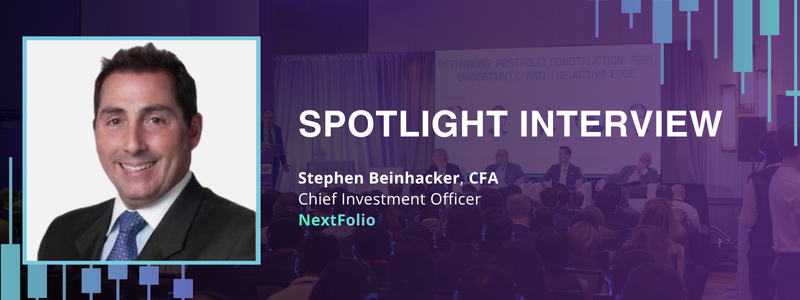
Stephen Beinhacker will join the AlphaX Fireside Chat at Future Alpha 2027 to discuss AI in the Investment Process: Evidencing Real Impact, Transparency & Novel Methods for Generating Alpha.